Barrettine Wood Care products are available from:
Toolstation: https://bit.ly/4s3wd9O
Wood Finishes Direct: https://bit.ly/4ceHe3e
More from Skillbuilder – https://skill-builder.uk/how-to-build-a-timber-frame-garden-room-2
@barrettineproducts2654
_______________________
Garden Timber: What Should You Replace and What Can You Save?
Not all Garden Timber needs replacing.
But some of it definitely does.
The real skill is knowing the difference.
On this job, we looked at a garden that had taken years of weathering, wear and exposure. The challenge wasn’t simply ripping everything out and starting again. It was deciding what had genuinely failed, what could be restored and what was still worth saving.
That distinction matters. Replacing every piece of tired-looking Garden Timber can be expensive and unnecessary. At the same time, trying to save timber that has genuinely lost its structural integrity can create bigger problems later.
The key is learning to look beyond appearance.
Timber can look grey, weathered and neglected while still being perfectly serviceable. Equally, a piece can look respectable on the surface while being badly deteriorated underneath.
Once the structure is sorted, the focus shifts to protecting the Garden Timber that’s staying.
Good preparation, the right treatment and regular maintenance can all help outdoor timber last longer.
Not All Weathered Garden Timber Is Rotten
One of the biggest mistakes people make when looking at old Garden Timber is assuming that grey or discoloured timber must be rotten.
Outdoor timber naturally changes appearance over time.
Sunlight can alter the surface, while rain, temperature changes and repeated wetting and drying can cause movement and weathering.
The result can be timber that looks dramatically different from the day it was installed.
But appearance alone doesn’t tell you whether the material has structurally failed.
A weathered surface can sometimes be cleaned, prepared and treated before a suitable protective finish is applied.
The important question is what is happening beneath that weathered surface.
Is the timber still firm?
Does it retain its shape?
Are joints still secure?
Are fixings sound?
Is there evidence of deep decay?
Those questions are much more useful than simply asking whether the timber looks old.
When Garden Timber Needs Replacing
There comes a point where restoration isn’t sensible.
If Garden Timber has significant structural decay, replacing it is generally the appropriate option.
This is particularly important for components carrying loads, including steps, handrails, posts and supporting beams.
If a structural component has become soft, seriously degraded or unable to perform its intended function, applying a coating won’t restore its strength.
A new coat might make deteriorated timber look better, but the underlying problem remains.
If the timber is supporting people or other parts of a structure, deterioration can become a safety concern.
The principle is simple:
If the timber has structurally failed, replace it.
Don’t confuse cosmetic restoration with structural repair.
What Garden Timber Can Be Saved?
Sound Garden Timber is a different story.
If the core remains strong and the deterioration is mainly on the surface, restoration may be worthwhile.
This is particularly common with older fences, gates, sheds, planters and garden structures.
The surface may be rough or grey, with old coating residue or areas of surface degradation.
But that doesn’t automatically mean the timber has reached the end of its useful life.
With proper preparation, tired-looking timber can sometimes be brought back into service.
The important thing is not to judge the material solely by appearance.
Inspect Before You Start
Before carrying out any Garden Timber restoration, inspect the entire structure.
Look at areas that remain wet for the longest.
Check where timber meets the ground.
Inspect joints and fixings.
Examine the underside of horizontal boards.
Look at the ends of timber sections.
Check areas where water can collect.
These locations can deteriorate faster because they may remain damp for longer.
A garden structure can therefore have perfectly respectable-looking boards alongside badly deteriorated areas hidden underneath.
A proper inspection helps identify what actually needs attention.
Ground Contact and Moisture
Timber close to the ground faces particularly challenging conditions.
Soil retains moisture, vegetation can restrict airflow and rainwater can splash against the base.
For Garden Timber, prolonged moisture exposure is one of the biggest threats to long-term durability.
This is why the base of posts and other low-level components deserve particular attention.
If timber remains wet repeatedly, the risk of deterioration increases.
Good detailing and drainage can therefore be just as important as the protective treatment applied to the surface.
Preparation Is Everything
Once you’ve established that the Garden Timber is worth saving, preparation becomes the next major step.
The temptation is to grab the treatment and start applying it immediately.
But putting a new coating over degraded or contaminated timber isn’t necessarily going to produce a durable result.
The surface may need cleaning.
Loose material may need removing.
Old coatings may need to be stripped back.
Rough or degraded areas may need attention.
Mould or algae may also need to be dealt with appropriately.
The objective is to create a suitable surface for the new treatment.
For more advice on preparing and protecting outdoor surfaces, you could internally link to your existing [timber treatment and maintenance guide – INSERT YOUR INTERNAL URL HERE].
Good preparation can take longer than the application itself, but it is often the most important part of the job.
Don’t Forget Cut Ends
Cut ends deserve particular attention when working with Garden Timber.
Whenever timber is cut, new material is exposed.
End grain can provide a pathway for moisture, making these areas particularly important when preparing and treating outdoor timber.
The same principle applies to drilled holes, notches and other areas where the timber has been cut or penetrated.
These details may look insignificant, but they can have a major impact on durability.
Protect vulnerable areas according to the requirements of the chosen timber treatment system.
Choose the Right Finish
There isn’t one universal product that is right for every piece of Garden Timber.
Different areas have different demands.
A decorative garden feature may need a finish chosen primarily for appearance and general weather protection.
A fence may require something different.
A gate that is handled regularly could experience more wear.
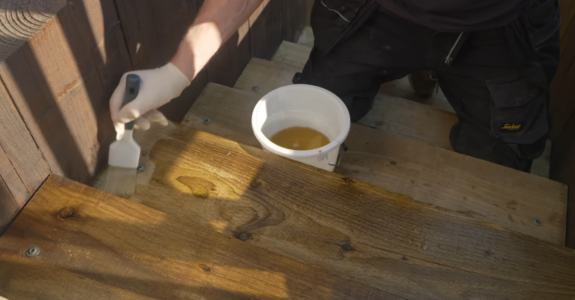
Steps are exposed to foot traffic as well as the weather.
Handrails can be touched constantly.
That’s why choosing a product based solely on colour isn’t enough.
Think about what the timber actually has to withstand.
High-Wear Garden Timber Needs More Attention
Steps are a particularly good example.
They experience rain, sunlight, temperature changes and repeated physical contact.
Every person walking across them creates wear.
If the finish is unsuitable for that level of use, it can deteriorate quickly.
High-wear Garden Timber therefore needs to be considered differently from a decorative fence panel.
The environment matters.
The use matters.
The preparation matters.
Maintenance Is Better Than Rescue
One of the best ways to extend the life of Garden Timber is to maintain it before serious deterioration occurs.
A small crack is easier to address than a severely degraded board.
A worn coating is easier to renew than timber that has been exposed for years without protection.
A damaged end can be treated before prolonged moisture exposure causes deeper problems.
Regular inspection doesn’t necessarily mean carrying out a major restoration every year.
A quick check can identify problems while they’re still manageable.
Don’t Replace Timber Just Because It’s Grey
Grey Garden Timber can look alarming, but weathering isn’t automatically failure.
If the material is still structurally sound, it may simply need appropriate preparation and protection.
Replacing everything because it looks old can create unnecessary expense and waste.
The better approach is to assess each component.
Some pieces may need replacing.
Others may need cleaning.
Some may require more substantial preparation.
And some may simply need a suitable protective finish.
But Don’t Try to Save Everything
The opposite mistake is equally important.
There is no prize for rescuing Garden Timber that has genuinely reached the end of its useful life.
If a component is severely rotten, unstable or structurally compromised, replacing it is the sensible decision.
Trying to preserve it with filler, paint or treatment may only delay the inevitable.
Knowing when to stop restoring is just as important as knowing when restoration is worthwhile.
Restore What You Can, Replace What You Must
The best approach to Garden Timber is neither to replace everything nor to save everything.
It’s about making the right call.
Some timber will have reached the end of its useful life.
Some will simply need the surface cleaned and prepared.
Some will need old coatings removed.
Some may need local repairs.
And some will simply need the right protective treatment to keep performing for years to come.
The skill is recognising which is which.
Don’t rip out sound timber simply because it has gone grey.
Don’t paint over timber that has structurally failed.
Inspect it. Understand it. Prepare it. Protect it. Replace only what genuinely needs replacing.
Good preparation is the difference between a finish that lasts and one that fails.
_______________________
#woodworking #DIY #decking #garden #homeimprovement #timber #outdoorprojects #restoration #howto