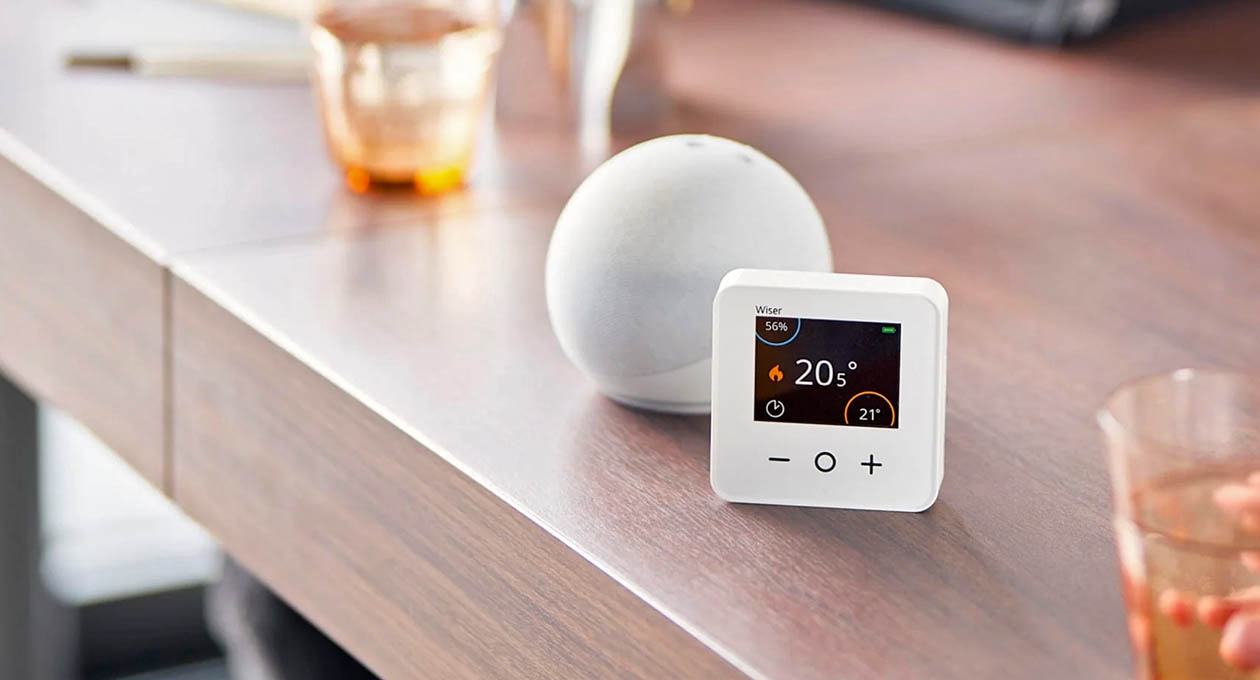
A year after fitting a complete Wiser Gen 2 system to a four-bedroom detached house, Skill Builder went back to finish the job. Two radiators were still without smart control, the lounge had a first generation Wiser radiator thermostat due an upgrade, and the conservatory had an electric panel heater running on its own. James Clark, Technical Training Manager at Drayton, joined the shoot to fit the new Wiser 2nd Generation Radiator Thermostat and the Wiser Electrical Heat Switch.
What went in first time round
The original installation replaced an old programmer with a three-channel hub, giving separate zones for upstairs heating, downstairs heating and hot water. A range of Wiser smart home devices went in alongside it, all managed from the Wiser Home app.
- Wiser 2nd Generation 3 Channel HubR
- Wiser Smart Room Thermostat
- Wiser Radiator Thermostats (first generation)
- Wiser Smart Plug
- Wiser Window & Door Sensor
- Wiser Water Leakage Sensor
- Wiser Motion Sensor
- Wiser Temperature & Humidity Sensor
- Wiser Battery Smoke Alarm
- Wiser Power Micro Module
Some were set up to work together through automations. The temperature and humidity sensor switches the bathroom fan on via the power micro module when humidity passes 60%, and the motion sensor turns on a lounge lamp through the smart plug.
What was added this time
- Wiser 2nd Generation Radiator Thermostat x 3
- Wiser Electrical Heat Switch
- Wiser Smart Room Thermostat (conservatory)
A year on
The hub connects to broadband for cloud services, but it also runs its own separate network for the Wiser devices, so losing broadband or Wi-Fi doesn’t mean losing control of the heating. In a larger house, the Wiser smart plugs and the Electrical Heat Switch also act as range extenders for that network. After a year of normal use, the only maintenance needed was some new batteries, and the app shows which devices need them.
The Wiser 2nd Generation Radiator Thermostat
The main improvement is the motor, which makes the new thermostat much quieter in operation. Battery life is longer too, with a set of AA alkaline batteries expected to last around two years, and it now works with rechargeable batteries. For local control, twist the cap towards plus for a 2°C boost that lasts an hour. Two adapters come in the box to suit most existing TRV valve bodies.
To fit one, turn the old mechanical TRV up to maximum to take the load off the pin, undo the collar and pull the head off. The valve body stays put, so there’s no draining down. Fit whichever adapter suits the valve, then put the batteries into the new head before fitting it, so the plunger is fully retracted. Screw the head on until it meets the adapter, then add about a quarter turn.
In the Wiser Home app, go to settings, devices and the plus button, then choose radiator thermostat. Twisting and holding the radiator thermostat to plus for around three seconds, until the LED flashes green, pairs it with the system. Holding it to minus until the motor runs calibrates it to the valve, and then it’s just a case of assigning it to a room and setting a schedule.
Upgrading from a first generation thermostat is simpler still. Identify the old head in the app, delete it, unscrew it, and fit the new one to the existing adapter. It goes back into the same room.
The Wiser Electrical Heat Switch
The Electrical Heat Switch brings electric heaters into the same app as the rest of the heating. It works as an inline switch, paired with either a Wiser room thermostat or a temperature and humidity sensor, so the heater responds to the temperature in the room. It will switch up to 16 amps of heating load, well above the roughly 5 amps drawn by the 1,000W panel heater here.
The switch is wired between the fused spur and the heater. It’s mains wiring, and James is a qualified electrician, so anyone fitting one at home should have it installed by a professional. It’s then added in the app and paired with a Wiser room thermostat, ideally sited out of direct sunlight and about 1.2 metres from the floor if wall mounted.
Building it up over time
Nothing from the original installation had to come out. A Wiser system can start with a hub and a thermostat, with rooms and devices added as they’re needed. The Wiser website has a product selector to find the right system for your home, and you can find an installer near you, too.
This article was produced in partnership with Wiser by Drayton.