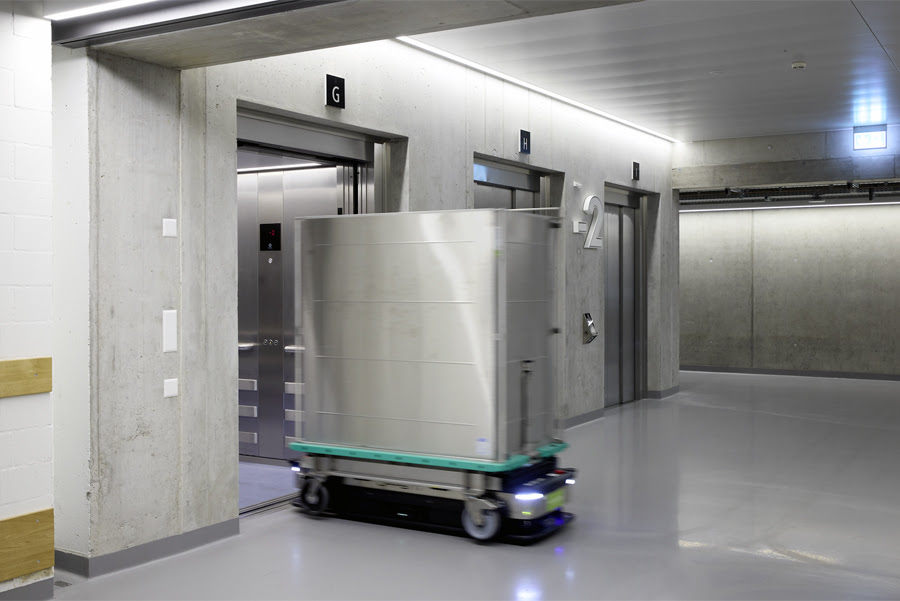
Schindler’s smart building solutions are redefining hospital logistics by connecting Automated Guided Vehicles with intelligent elevator systems
Healthcare facilities are becoming increasingly connected, with intelligent building technology playing a greater role in day-to-day operations. One of the biggest developments is the rise of Automated Guided Vehicles (AGVs), autonomous robots designed to transport supplies safely and efficiently throughout hospitals.
From delivering meals and clean laundry to transporting medicines, sterile equipment and clinical waste, Automated Guided Vehicles are helping hospitals streamline logistics and free up valuable staff time. However, while the robots often receive the attention, they can only operate effectively if the building itself is intelligent enough to support them.
This is where Schindler is leading the way.
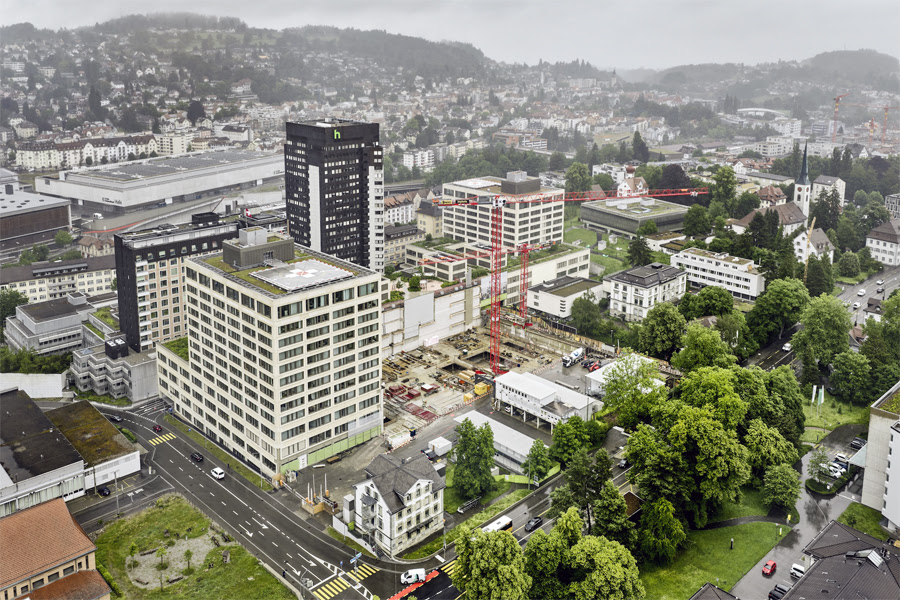
At HOCH Health Ostschweiz in St. Gallen, Switzerland, Schindler has successfully integrated Automated Guided Vehicles with its intelligent elevator systems and digital building technologies, creating one of Europe’s most advanced examples of automated hospital logistics.
Automated Guided Vehicles Need More Than Just Robots
Modern hospitals are complex environments, with thousands of people, supplies and pieces of equipment moving through the building every day. While Automated Guided Vehicles can navigate corridors independently, moving between multiple floors presents a completely different challenge.
Without intelligent elevator integration, an autonomous robot would simply stop at the lift and wait for human assistance.
Schindler has solved this challenge by creating an ecosystem where elevators, robots and building management systems communicate with one another automatically, allowing Automated Guided Vehicles to travel throughout an entire hospital without manual intervention.
A Smart Hospital Built Around Intelligent Mobility
HOCH Health Ostschweiz is currently undergoing one of Switzerland’s largest hospital modernisation programmes, with the newly completed Haus 07A/B representing a major milestone in the redevelopment.
The new facilities include a large operating and interventional floor alongside 96 modern patient rooms, all supported by Schindler’s vertical transportation technology.
Haus 07A alone features 20 Schindler elevators, while a further six elevators are being installed in Haus 07B as construction continues.
Originally, the project focused on modernising the hospital’s vertical transportation systems. During construction, however, the hospital identified a growing need to support Automated Guided Vehicles across the campus.
Rather than treating this as a separate project, Schindler adapted the building infrastructure, expanding its digital ecosystem so autonomous robots could become a fully integrated part of the hospital’s daily operations.
Schindler StratOS Creates One Connected Ecosystem
At the heart of the project is Schindler StratOS, the company’s digital ecosystem that connects multiple technologies into a single interoperable platform.
Rather than operating as standalone systems, elevators, robotics, access management and building controls work together, allowing hospitals to add new technologies as their requirements evolve.
As Florian Trösch, Head of Global Digital Business at Schindler, explains, every digital solution within Schindler StratOS is designed to work together, providing customers with the flexibility to scale projects and introduce new capabilities without redesigning existing infrastructure.
That flexibility proved particularly valuable at HOCH Health Ostschweiz, where the requirement for Automated Guided Vehicles was introduced after construction had already begun.
Schindler CoLab Allows Automated Guided Vehicles To Use Elevators
The key technology enabling the project is Schindler CoLab, the company’s building integration platform.
Schindler CoLab allows third-party software controlling Automated Guided Vehicles to communicate directly with Schindler’s elevator systems.
When a robot approaches an elevator, it automatically sends a request through Schindler CoLab.
The system calls the appropriate lift, ensures the doors remain open long enough for the robot to enter, transports it to the correct floor and allows it to continue its journey without requiring any assistance from hospital staff.
This seamless communication between robots and elevators transforms what would otherwise be isolated technologies into one intelligent logistics network.
Schindler PORT Optimises The Movement Of People And Robots
Alongside Schindler CoLab, the project also uses the Schindler PORT transit management system.
Designed for large and complex buildings, Schindler PORT manages elevator traffic intelligently, reducing waiting times while improving passenger flow throughout the hospital.
By integrating Automated Guided Vehicles into the same system, Schindler ensures robots and people can move safely and efficiently within the building, maintaining smooth operations even during busy periods.
Rather than competing for elevator capacity, passengers and autonomous robots become part of one coordinated transportation strategy.
More Than 30 Automated Guided Vehicles Already In Operation
Today, more than 30 Automated Guided Vehicles supplied and managed by Schindler’s robotics partner are already operating within the hospital.
Using third-party navigation software connected through Schindler CoLab and Schindler PORT, the robots transport food, laundry, medical equipment and waste throughout the campus while travelling independently between floors.
The success of the initial deployment has led to further expansion.
By the time the hospital’s redevelopment is completed in 2027, every elevator across the campus will be fully prepared to support Automated Guided Vehicles, allowing up to 50 autonomous robots to operate throughout the site.
This will position HOCH Health Ostschweiz among Europe’s leading examples of intelligent hospital logistics.
A Blueprint For Future Healthcare Buildings
Although Schindler has previously delivered successful Automated Guided Vehicles integration projects across sectors including retail and hospitality, healthcare presents an even greater challenge.
Hospitals require continuous operation, exceptional reliability and the highest standards of safety. Every movement must be carefully coordinated without disrupting patients, visitors or clinical staff.
The successful deployment at HOCH Health Ostschweiz demonstrates that intelligent building infrastructure can meet these demanding requirements while supporting increasingly automated healthcare environments.
Rather than simply supplying elevators, Schindler has shown how digital building technologies can become the backbone of modern hospital logistics.
The Future Of Automated Guided Vehicles
As hospitals continue investing in digital transformation, Automated Guided Vehicles are expected to play an increasingly important role in healthcare logistics.
However, autonomous robots alone are only part of the solution.
Their full potential depends on intelligent buildings capable of connecting elevators, robotics, access management and building systems into one coordinated ecosystem.
The work completed by Schindler at HOCH Health Ostschweiz demonstrates exactly how this can be achieved.
By combining advanced elevators with Schindler StratOS, Schindler CoLab and Schindler PORT, the company has created an infrastructure where Automated Guided Vehicles can operate seamlessly across an entire hospital campus.
As healthcare facilities become smarter and increasingly automated, projects such as this offer a compelling blueprint for the next generation of hospital design, proving that intelligent mobility is no longer just about moving people – it is about connecting every part of a building into one efficient, integrated system.