Spray foam insulation has become one of the most controversial ways to improve the energy efficiency of a home. Marketed as a fast and effective way to insulate lofts and roofs, spray foam can reduce heat loss, improve airtightness and help create a warmer home.
However, it is not a simple solution that is suitable for every property.
The type of spray foam used, the condition of the roof, the way it is installed and the existing ventilation can all affect whether the system performs successfully. In some cases, poorly specified or incorrectly installed spray foam insulation can create serious problems for homeowners.
This guide explains how spray foam works, the difference between open-cell and closed-cell foam, the potential risks to roof structures and why some mortgage lenders may be reluctant to lend on properties where spray foam has been installed.
What Is Spray Foam Insulation?
Spray foam insulation is a liquid material that is sprayed onto a surface before expanding and curing into a layer of insulation. It is commonly used in lofts and roof spaces, where it can be applied to the underside of the roof covering or between and around roof rafters.
Unlike traditional insulation materials such as mineral wool, fibreglass or rigid insulation boards, spray foam expands after application. This allows it to fill gaps and irregular spaces, potentially creating a continuous layer of insulation.
That ability to expand is one of the reasons spray foam became popular. Older roofs can contain awkward corners, gaps and irregular spaces that can be difficult to insulate using conventional products.
However, the same characteristic that makes spray foam insulation useful can also create problems if the material is applied without proper assessment of the roof construction.
Open-Cell vs Closed-Cell Spray Foam
There are two main types of spray foam insulation used in buildings: open-cell and closed-cell foam.
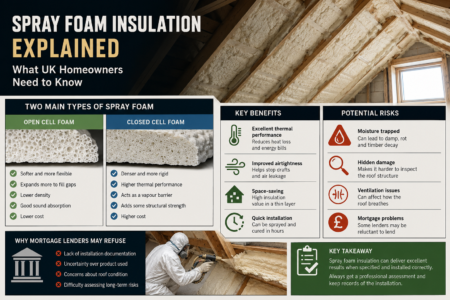
Open-cell foam has a more flexible structure and contains interconnected air pockets. It is generally softer and less dense than closed-cell foam. Because it expands significantly, it can fill larger gaps and irregular spaces.
Closed-cell foam is denser and more rigid. Its cells are largely sealed, giving it different thermal and moisture characteristics. It can provide a high level of insulation in a relatively thin layer and may also add some structural rigidity to the surface to which it is applied.
However, neither type of spray foam insulation should automatically be considered the right choice for every roof.
The correct specification depends on the construction of the building, the condition of the roof, the level of ventilation and how moisture is expected to move through the structure.
This is particularly important in older UK homes, where roofs may have been designed to breathe differently from modern buildings. Changing the way a roof is insulated can therefore alter the movement of air and moisture within the roof space.
Insulation Must Work With the Roof, Not Against It
A roof is not simply a barrier designed to keep rain out. It is part of a wider building system in which moisture, air movement and temperature all interact.
Traditional roofs may rely on ventilation to remove moisture from the roof space. If spray foam insulation is installed in a way that blocks existing ventilation routes, the conditions within the roof structure can change.
This is one of the reasons a proper assessment is important before any spray foam insulation is applied.
Insulation should not be considered in isolation. The condition of the roof covering, the underlay, the rafters, the eaves and the existing ventilation all need to be considered together.
A roof that already has water ingress, condensation or timber decay should not simply be covered with insulation and left untreated. Any existing problems need to be understood before the insulation system is installed.
Can Spray Foam Insulation Damage a Roof?
The presence of spray foam insulation does not automatically mean that a roof has been damaged.
However, concerns have been raised about situations where spray foam has been installed over roof timbers or roof coverings without sufficient inspection or consideration of the existing construction.
If moisture enters the roof structure, spray foam can potentially make inspection more difficult. Areas of timber may become hidden from view, making it harder to identify problems such as rot, decay or insect attack.
In some situations, concerns have also been raised about the interaction between foam, roof coverings and timber. The precise risk depends on the product, the installation method and the condition of the roof.
The key point is that spray foam insulation can make future inspection and maintenance more complicated. A roof may still be perfectly sound, but assessing its condition can become more difficult once parts of the structure are covered.
This is particularly important when buying or selling a property. A surveyor may need to establish the condition of the roof and the materials used before being able to provide a clear assessment.
Why Do Some Mortgage Lenders Refuse Homes With Spray Foam?
One of the biggest concerns for homeowners is the impact spray foam insulation can have on obtaining a mortgage.
Some mortgage lenders have historically been reluctant to lend on properties where spray foam has been installed. This does not necessarily mean that every property containing spray foam is unmortgageable.
Instead, lenders may require additional information before deciding whether the property represents an acceptable security.
This can include details about the product used, the installation method, the condition of the roof and the findings of an independent survey.
The difficulty is that spray foam insulation is often hidden once installed. If the homeowner cannot provide documentation showing what product was used and how it was installed, obtaining an assessment may become more complicated.
For a homeowner looking to sell, this can create delays and additional costs.
A buyer may be concerned that their mortgage lender will not accept the property. The buyer may then request further surveys or ask the seller to provide evidence that the installation was carried out correctly.
In some cases, the issue can become a negotiation point during the sale.
This is why homeowners should keep records of any spray foam insulation installation, including product information, installer details and any relevant assessments or guarantees.
Is Spray Foam Insulation Right for Your Home?
There is no simple yes-or-no answer.
Spray foam insulation can provide useful thermal performance benefits when the correct product is specified and installed correctly in a suitable building.
However, it is not a universal solution for every loft or roof.
Before installing spray foam insulation, homeowners should consider:
- The age and construction of the property
- The condition of the roof timbers
- Existing ventilation
- The type of roof covering and underlay
- The type of spray foam being proposed
- How the installation will affect future inspections
- Whether the work could affect future mortgage or resale plans
A proper assessment is particularly important where there are already signs of dampness, condensation or roof defects.
The temptation with any insulation system is to focus on the headline benefit: a warmer home and reduced heat loss. But the performance of insulation depends on how it interacts with the rest of the building.
The Bottom Line for UK Homeowners
Spray foam insulation is not automatically good or bad.
Its performance depends heavily on the property, the roof construction, the product selected and the quality of the installation.
The biggest mistake is treating spray foam as a quick fix for every cold loft or poorly insulated roof.
Insulation needs to be part of a wider strategy that considers ventilation, moisture movement, roof condition and the long-term maintenance of the building.
For homeowners considering spray foam insulation, the best approach is to understand the roof first and choose the insulation system second.
And if spray foam is already installed, do not automatically assume that the roof is defective or that the property cannot be mortgaged. Instead, gather as much information as possible about the product and installation, arrange an appropriate assessment where necessary and establish the actual condition of the roof.
The right insulation can improve the energy performance of a home. But the wrong insulation system, installed in the wrong place or without understanding the building, can create problems that are far more expensive to resolve later.
🔑 Key Takeaways
• Professionally applied spray foam is not the same as the DIY stuff from a can
• Open cell and closed cell foams behave very differently — the wrong choice for your roof type can cause serious moisture problems
• Surveyors can’t see behind foam without an invasive inspection, which is why mortgage lenders get nervous
• Ventilation is non-negotiable — spray foam alone is never the complete solution
• If you have it done, get the guarantee underwritten by an insurance company, not just the installer
• DIY spray foam kits are high risk unless you really know what you’re doing
• If you’re planning to sell, think very carefully before going ahead
📋 Before You Commit
Get your roof properly surveyed, document everything, and make sure you understand what membrane — if any — is currently in your roof space. The foam itself isn’t the enemy. Poor installation and the wrong product for the wrong roof is.
📬 Got experience with spray foam? Drop it in the comments — good or bad, it all helps someone else make a better decision.
More from Skillbuilder – https://skill-builder.uk/spray-foam-insulation-the-ugly-truth
#SprayFoamInsulation #LoftInsulation #UKProperty