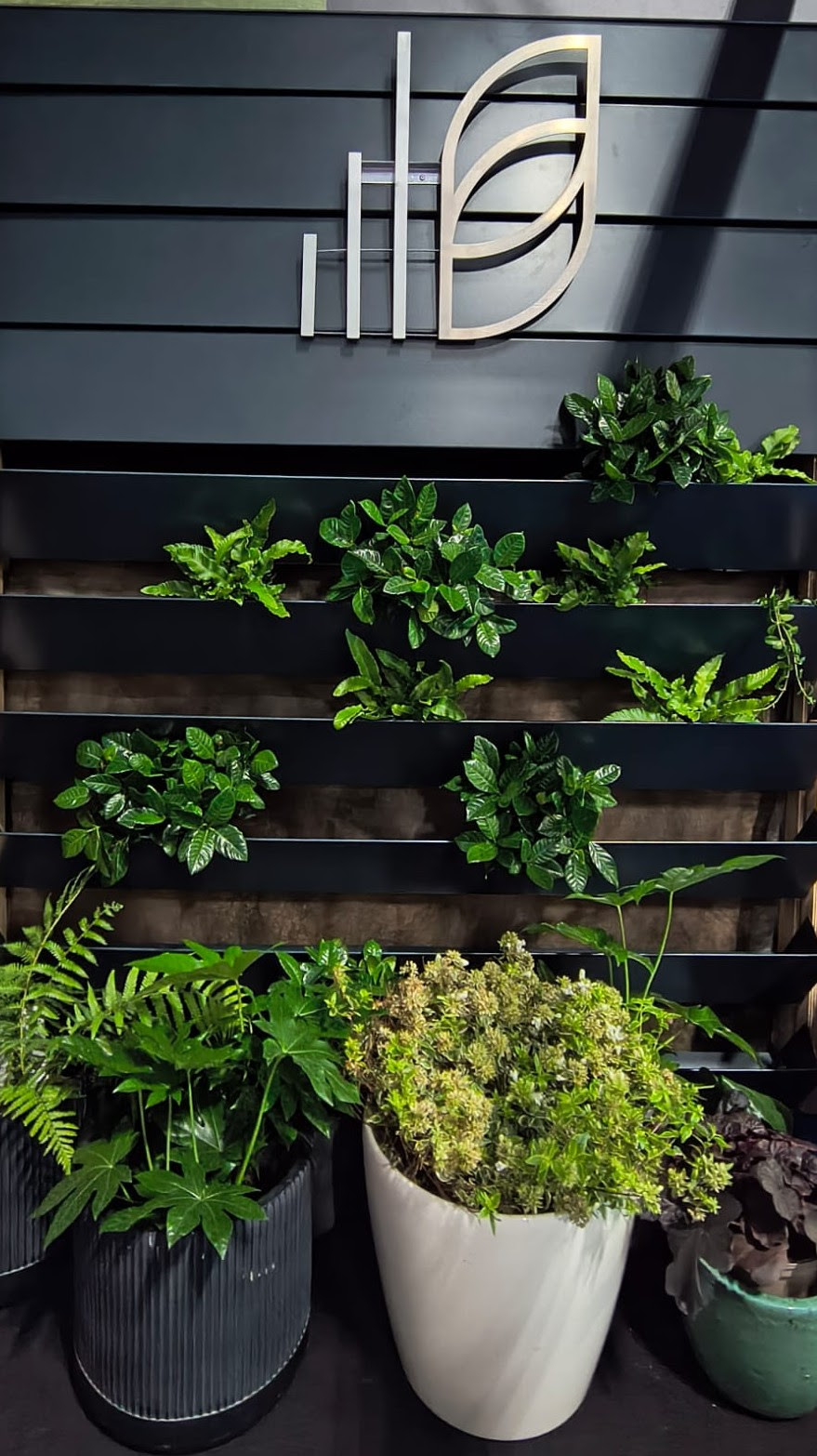
A new adaptable living wall cladding system aims to address one of the biggest challenges facing vertical gardens: what happens when building owners no longer want the planting?
Living walls can transform otherwise uninspiring building façades, bringing greenery into urban environments while adding visual interest to residential and commercial developments. However, maintaining a planted façade over the long term can be challenging, particularly when buildings change ownership or maintenance priorities shift.
Now, UK living wall specialist Life on Walls is taking a different approach with its new Dynamic Louvre System (DLS), which allows a façade to switch between planted living wall cladding and a contemporary aluminium finish without replacing the underlying structure.
The system is being launched at FutureScape 2026 and offers an interesting alternative to conventional fixed living walls, giving architects, landscape designers and building owners greater flexibility over how their external spaces are used.
A living wall that can change its appearance
At the heart of the Dynamic Louvre System is a series of horizontal aluminium louvres that can be opened to accommodate planting or closed to create a clean, architectural cladding finish.
Unlike traditional living wall installations, where planting is an integral and relatively permanent feature, DLS allows individual sections of the façade to be adapted independently.
The louvres can be operated separately or linked together, allowing different planting patterns, densities and configurations to be created across a building’s exterior.
Importantly, when planting is no longer wanted, the plants can be removed and the louvres closed. The installation effectively returns to an aluminium cladding system without requiring the supporting structure to be dismantled or replaced.
This could be particularly useful in buildings where ownership, occupancy or design preferences are likely to change over time.
For example, in multi-occupancy developments, individual residents could decide whether they want planting incorporated into their section of the façade. Homeowners could also adapt their planting seasonally, rather than committing to a permanently green exterior.
Addressing the maintenance challenge
One of the difficulties with conventional living walls is that their long-term success depends on consistent maintenance.
Irrigation, plant health, replacement planting and general upkeep all need to be considered. When maintenance is neglected, the results can be disappointing, with dead or deteriorating plants potentially making a building look worse rather than better.
Life on Walls founder Armando Raish believes this is an issue that can undermine confidence in vertical greening.
His argument is that the problem is not necessarily living walls themselves, but the assumption that a building’s façade must remain permanently planted, regardless of changing circumstances.
The DLS approach is to make the planting optional rather than an irreversible design decision.
For the construction industry, this raises an interesting question about how adaptable external finishes could help extend the useful life of architectural features, particularly on buildings with multiple occupants or changing ownership.
Aluminium construction and integrated irrigation
The Dynamic Louvre System is manufactured from lightweight, recyclable aluminium, combining a durable metal structure with the flexibility of a modular planting arrangement.
The panels can be specified in a range of colours and finishes, including printed wraps, allowing the system to complement different architectural styles.
An integrated irrigation system is concealed within the structure. It automatically redirects water away from closed louvres, helping to avoid unnecessary water consumption when sections of the façade are not being used for planting.
Installation has also been considered, with Life on Walls designing the system to be fitted using standard tools by competent tradespeople.
This should help make it suitable for both new-build developments and refurbishment projects, although individual project requirements and installation specifications will naturally need to be assessed.
What could living wall cladding cost?
Life on Walls is currently manufacturing the Dynamic Louvre System to order, with bespoke configurations available to suit individual projects.
Indicative installed costs are expected to be around £250 to £300 per square metre for the aluminium panels, excluding plants. The final price will depend on the specification.
While this positions the system as a specialist façade solution rather than a straightforward alternative to conventional cladding, its ability to change function could offer additional value over the lifetime of a building.
The company’s longer-term ambition is to scale production and make the system more commercially competitive with traditional static cladding products.
Could adaptable façades change the way we design buildings?
The idea behind DLS is relatively straightforward, but it challenges the conventional approach to living wall design.
Rather than treating planting as a permanent feature that building owners must maintain indefinitely, it introduces the possibility of changing the façade as circumstances evolve.
That could open up opportunities for vertical greening on commercial buildings, hospitality developments, residential properties and even smaller spaces such as balconies and terraces.
There are still practical considerations around long-term durability, maintenance requirements and the economics of installation, but the concept offers an alternative worth watching.
Life on Walls is officially unveiling its Dynamic Louvre System at FutureScape 2026, where visitors can see the technology in operation at Stand F8.
For architects, contractors and building owners, it is an interesting development in the growing market for adaptable building façades. After all, a green wall might be desirable today, but that doesn’t necessarily mean it needs to stay green forever.