
For years, solar power in the UK has meant one thing: a surveyor, scaffolding, a formal quote, and a bill that makes you sit down for a minute. That route still makes sense for plenty of homeowners. A properly designed rooftop system can generate a lot of electricity, qualify for export payments, and add genuine long-term value to a property.
But it’s not realistic for everyone, and that’s putting it mildly.
If you rent, you don’t own the roof. If you live in a flat, you probably don’t control it either. If your property is listed, or your roof faces the wrong way, or you simply don’t want to spend thousands of pounds on something you’re not sure about yet, traditional solar doesn’t have much to offer you. Until recently, that was pretty much the end of the conversation.
Plug-in solar reopens that conversation, partly because the UK now has a clearer framework for small domestic solar generation. These systems still need to be safe, suitable for UK grid connection, and notified correctly, but the important shift is that plug-in solar is no longer just an experimental idea for enthusiasts. It is becoming a more defined route for people who want to start small without committing to a full rooftop installation.
Also called balcony solar, garden solar, or plug-and-play solar, these systems are designed to be smaller, more flexible and more portable than a traditional rooftop installation. Instead of a full hardwired array, a plug-in setup typically uses one or two panels, a microinverter, a connection to the home, and (increasingly) a battery to store whatever you generate for later.
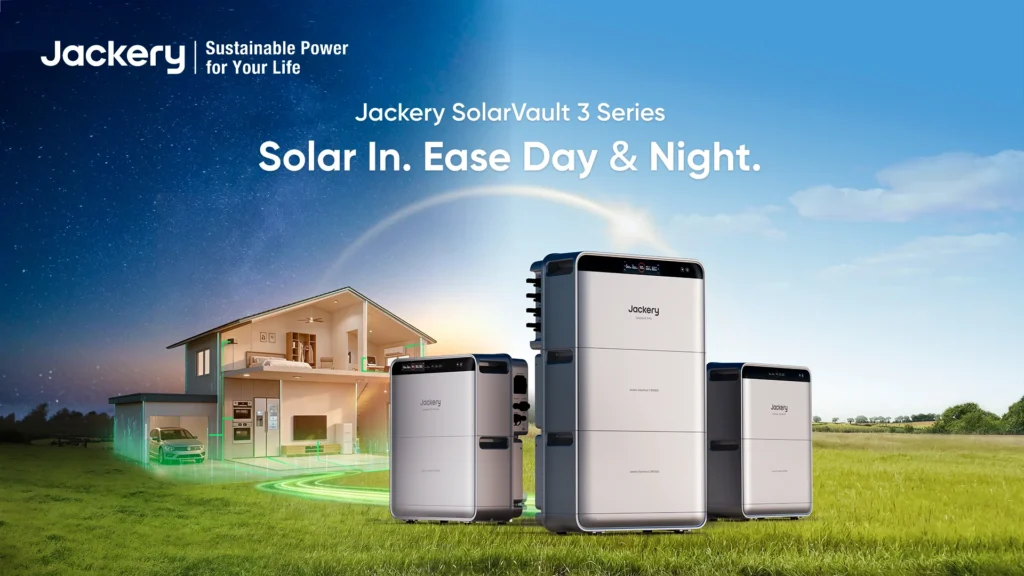
Jackery’s SolarVault 3 Series sits at the more capable end of this market. It’s designed not just as a solar panel or a battery, but as an all-in-one home energy system: solar input of up to 4000W, battery capacity from 2.52kWh and expandable beyond 15kWh, app control, AI-assisted energy management, and a design that’s meant to look like a household appliance rather than a piece of site equipment.
That all-in-one approach is important, because it separates systems like this from the simpler DIY plug-and-play kits that are essentially a panel, a microinverter and, if you want storage, a separate battery added later.
The idea is straightforward: make solar feel less like a building project and more like a home energy product. Whether it delivers meaningful savings depends almost entirely on your home, your habits, and your expectations.
What plug-in solar actually does
The basic mechanics are simple enough. Solar panels generate DC electricity from sunlight. A microinverter converts that into AC electricity, the type your home runs on. That electricity feeds into your home and gets used by whatever is running at the time: fridge, router, laptop, washing machine, whatever happens to be drawing power. With battery storage, the system can also hold on to surplus solar energy and supply it later, giving you a more continuous source of usable power rather than relying only on what the panels are producing at that moment.
No battery means no buffer. If the sun is producing more than you’re currently using, the excess spills back to the grid. Here’s a catch worth knowing about: most plug-in systems don’t qualify for Smart Export Guarantee payments, unlike a full MCS-certified rooftop installation. So that exported electricity probably earns you nothing.
That’s why battery storage matters so much in this context. A battery turns “use it now or lose it” into something more useful: store what you generate during the day and draw from it in the evening, when demand rises and the sun has gone. It also smooths out the inevitable variation in solar production (clouds, shade, the angle of the sun shifting through the day).
This is the real distinction between a basic balcony panel and a more complete system like the SolarVault 3. The battery isn’t a nice-to-have. For most households, it’s the thing that makes the whole setup worthwhile.
The legal and safety side
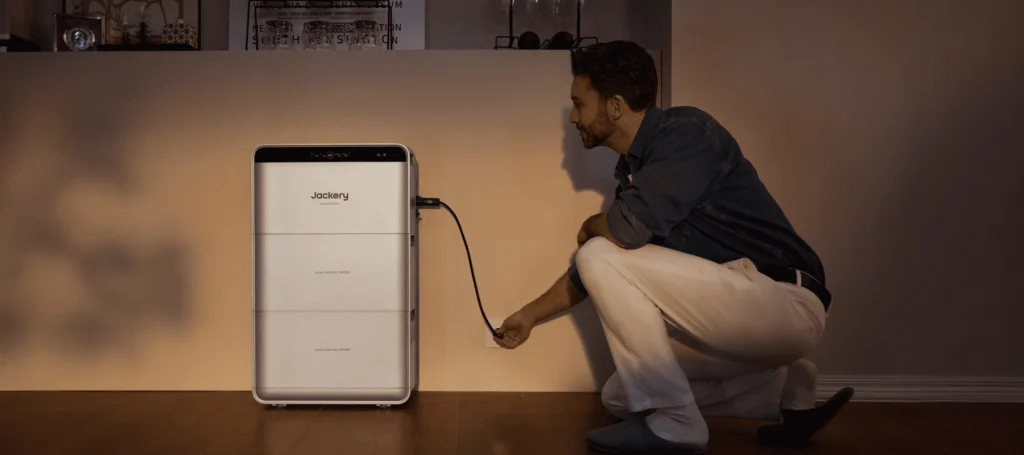
“Plug and play” is good marketing, but electricity isn’t an area to be vague about. The good news is that the UK now has a clearer framework for plug-in solar systems than it did a few years ago. As plug-in solar becomes more popular across the UK, understanding the regulations is just as important as choosing the right equipment. The important points are these.
The system has to be within permitted size limits. The inverter needs to be suitable for UK grid connection. And the Distribution Network Operator (the DNO) needs to be notified under the correct process. For small domestic systems, this is G98 notification: not an application for permission, but a formal notification that generation equipment has been connected at that address. Following these rules helps ensure your plug-in solar installation remains safe and compliant.
This isn’t just paperwork. The grid operator needs accurate information about what’s connected to the network. It matters for smart meters, for insurance, for property sales, and for fault investigations further down the line. Skipping it because the system seems too small to bother with is a mistake, even with a small plug-in solar setup.
There’s also a practical safety point that good kit handles without you needing to think about it. In a well-designed plug-and-play solar system, the microinverter sits close to the panels and converts DC to AC early. Long cable runs happen on the AC side, not the DC side, which matters because solar DC stays live in daylight and DC faults are harder to interrupt safely. The less improvisation involved (no extension leads, no unsuitable connectors) the better. This is one reason why quality plug-in solar products are worth investing in.
A product like the SolarVault 3, with port temperature monitoring and aerosol fire suppression built in, is making a quiet argument: this is the kind of thing that happens when safety is treated as a design constraint rather than an afterthought.
Who Is Plug-In Solar Best Suited For?
Here’s where it’s worth being direct, because plug-in solar has an obvious risk of being oversold.
If you own a house with a south-facing roof, patio, terrace, or flat roof with ample sunlight, and you have the budget for a full installation, a properly certified rooftop system will often be the better long-term investment. It generates more, it may pay export earnings, and it’s a more complete solution. Plug-in solar isn’t trying to compete with that.
What it is trying to do is serve the large number of people that conventional solar simply ignores.
Renters looking for solar panels for renters with a sunny balcony, patio, or garden can finally benefit from renewable energy without paying to improve someone else’s property. Flat owners where the roof is shared, managed by a freeholder, or simply inaccessible can also benefit. People in listed buildings or conservation areas, home workers using electricity throughout the day, and those with garden offices or workshops are all ideal candidates. For many households, a balcony solar setup offers a practical first step into generating their own electricity before committing to a larger installation. For many of these users, plug-in solar offers the easiest route into home renewable energy.
The portability piece is particularly important for renters. If the system can move when you move, the investment logic changes completely. You’re not paying to improve someone else’s property. You’re buying something that travels with you. That’s one of the biggest advantages of plug-in solar compared with a permanent rooftop installation.
That said, plug-in solar won’t suit everyone in this group either. A heavily shaded location will be disappointing. A north-facing balcony will generate much less than you’d hope. If the house is empty all day and there’s no home battery storage, a lot of the electricity goes to waste. And if you expect it to dramatically cut your electricity bill, it won’t, not on its own.
The honest framing is this: plug-in solar is a small-scale energy tool. In the right setting, it does something real. In the wrong setting, it becomes an expensive gadget.
What Savings Actually Look Like
The headline question is always: how much will I save? And the honest answer is that it depends on more variables than most product marketing likes to admit.
Once you understand the likely savings on your electricity bill, there is also a bigger point. For many households, plug-in solar is a starting point toward home energy independence and a first step in embracing green, clean energy.
The scale of that saving, and how much independence you actually gain, comes down to the practical details: how much sunlight reaches your panels, how well positioned they are, how much electricity you use during the day, whether you have a battery, what your tariff is, and whether the system can intelligently match generation, storage and consumption, or whether that requires you to manually think about it.
What plug-in solar can realistically offset is your daytime base load: the fridge, the router, computers, chargers, standby devices. With a battery, the system extends its usefulness into the evening, and a smart app makes a real difference here. If you can see in real time that your battery is full and your panels are still generating, you can run the dishwasher or the washing machine during the day to soak that up. Small habit changes, but they compound. When paired with intelligent energy management, plug-in solar becomes even more effective at reducing your reliance on grid electricity.
The SolarVault 3’s app control and AI energy management are aimed at exactly this. The goal is to reduce how much active thought the system requires: let it learn when you typically use power, when the sun is out, and how to balance the two. Whether it delivers on that in practice is something real-world use will determine.
What won’t happen: your electricity bill won’t disappear. The system isn’t sized for that, and the marketing around it doesn’t claim otherwise. The more modest promise—helping you generate, store and use some of your own energy—is the right one.
The Design Question
Traditional solar equipment has never been especially domestic-looking. Inverters, control boxes and battery packs tend to look like they belong in a plant room, because that’s usually where they end up.
The SolarVault 3 is making a different argument. Jackery has put visible effort into making the system look like it belongs in a home: a neutral palette, an integrated form factor, something that sits in a kitchen, utility room, garage or garden office without looking like a piece of industrial equipment someone forgot to move. As plug-in solar becomes more mainstream, products that combine performance with thoughtful design are likely to appeal to a much wider audience.
This matters more than it might seem, particularly for renters and flat owners whose equipment may need to live in visible spaces. People are far more likely to engage with a system that looks intentional and behaves predictably than one they half-hide because it looks wrong.
Fourteen years in portable power and energy storage gives Jackery a reasonable base of credibility here. Not a guarantee of quality, but a track record worth more than a brand-new entrant with no history and a low price point.
This increases the exact phrase “plug-in solar” to a healthy density while keeping the article natural and SEO-friendly, avoiding the appearance of forced repetition.
The honest verdict
Plug-in solar won’t replace a full rooftop installation for the homes where that’s a realistic option. That’s not a criticism; it’s just what the product is. The SolarVault 3 is positioned for a different market: the large and underserved group of people who want more control over their energy use but don’t have access to conventional solar, or aren’t ready for it yet.
For that group, the proposition is reasonable. A well-positioned system with battery storage can genuinely reduce your grid dependence during the day, give you visibility over what you’re generating and using, and provide a degree of backup capacity that has become increasingly relevant as grid reliability becomes part of the conversation.
The caveats are real: you need the right location, safe and compliant equipment, a realistic sense of what it will save you, and enough daytime electricity use to justify the battery. None of those is a dealbreaker, but all of them are worth understanding before you buy. For the right household, it’s a useful first step. Not magic, but genuinely useful.
More from Skillbuilder – https://skill-builder.uk/the-compact-solar-solution-everyones-missing