The British Institute of Kitchen, Bedroom & Bathroom Installation (BiKBBI) announced that VictoriaPlum.com (Trade) have become that latest blue-chip brand to become a Corporate Sponsor of the organisation.
Founded in 2001, VictoriaPlum.com have been at the forefront of online bathroom buying for nearly 20 years, pioneering new and innovative ways to help make life easier for their customers. As a major bathroom retailer, VictoriaPlum.com have helped almost 2 million customers across the UK, with work extensively across the ‘Trade’ sector, having attracted 20,000 trade customers.
James Garrison, Head of Trade, said “We’re very proud to become a Corporate Sponsor of BiKBBI and be part of the great work they do through Education, Standards and Support. At VictoriaPlum.com, we strive to give Best in Sector customer service through our dedicated Trade Account Management Team, supporting our industry through providing over 6,000 products and advice while making sure that the installers we work with, feel supported and valued, which is reflected in our Trust Pilot score. I am really looking forward to working closely with BiKBBI and its members in the coming months and years.”
BiKBBI CEO, Damian Walters added: “What a great start to 2020. It’s great that the team at Victoria Plum Trade have supported installations via their corporate sponsorship of BiKBBI. It’s another great brand that shares our vision and we’re looking for more to ‘get on the bus’ and join our journey!”
Huntingdon, UK … 8 January 2020 … Goodfellow is pleased to announce the availability of their new range of Perovskites, a group of materials that demonstrate great potential for optoelectronic applications.
Perovskites have a unique and versatile crystal structure that consists of a variation in the chemical formula ABX3. Many Perovskites occur as oxides (ABO3), where A and B are typically metal cations. Due to their lattice, these materials are characterised by special properties like superconductivity, magnetoresistance, piezoelectricity and dielectric and pyroelectric behaviour. Therefore, Perovskites are excellent candidates for multilayer capacitors like fuel cells, solar cells, sensors and electric batteries, or even next-generation display screens, LEDs, memory devices (RAM) and high-temperature superconductors.
Goodfellow’s range of Perovskites includes powder and solid forms of:
Barium Titanate
Bismuth Aluminate
Bismuth Titanium Oxide
Calcium Titanate
Copper Tungsten Oxide
Lithium Titanate
Lead Titanium Oxide
Lanthanum Titanate
Samarium Ferrite
For more information, email technical@goodfellow.com, contact a Goodfellow technical expert on 0800 731 4653 (UK) or +44 1480 424 800, or click here for a technical data sheet. About Goodfellow
For more than 50 years, Goodfellow has been a leading supplier of metals, polymers, ceramics and other materials to meet the needs of science and industry worldwide. The company specialises in supplying small quantities (a few grams to a few kilos) of metals and materials for research, prototype development and specialised manufacturing applications. Standard products can be found online at the comprehensive Goodfellow Catalogue. Custom products and materials in larger quantities are available upon request at info@goodfellow.com. Goodfellow Cambridge Limited
Ermine Business Park, Huntingdon, PE29 6WR, UK
Telephone: +44 1480 424800 Fax: +44 1480 424900
E-mail: info@goodfellow.com Web: www.goodfellow.com
Thanks to Dollar Shave Club for sponsoring. Go to http://uk.DollarShaveClub.com/skillbuilder to get your starter set for £5. After that, the restock box comes with regular-sized products at regular price.
Subscribe to Skill Builder for more bathroom renovation remodel tutorials.
Many simply do not realise the dangers when it comes to permanent damage regular noise can cause. However, with adequate protection to look after your hearing, damage can easily be avoided.
Peter Dumigan, managing director of the Hultafors Group UK, owners of Snickers Workwear, Solid Gear Safety Footwear and Hellberg Safety PPE writes:
Long term damage to your hearing can be caused by the noise from regular daily use of even the most basic hand tools – drills, angle grinders, disc cutters, circular saws, even hammers – if you don’t wear proper ear protection.
The Control of Noise at Work Regulations 2005 are designed for workers on-site, from the risks caused by noise.
Noise-induced hearing loss is the most commonly reported occupational disease with over 800 million people around the world are affected by the condition.
Over 30% of all workers are exposed to hazardous noise levels and one in four manufacturing workers who are exposed to loud noise does not use hearing protectors.
Hearing damage caused by exposure to noise at work is permanent and incurable, with research estimating that over 2 million people can be exposed to noise levels that are potentially harmful.
More often than not, hearing loss is gradual as a result of prolonged exposure to noise, but when combined with the normal loss of hearing as you age it becomes a rapidly deteriorating condition.
As an added hazard, exposure to unsafe noise levels can also result in tinnitus, a permanent sensation of background ringing or buzzing your ears. But in the most serious of cases, immediate damage to your hearing can also be caused by sudden loud noises.
Regulatory Protection
As far as the health and safety regulations are concerned, the noise threshold for providing hearing protection is now a daily exposure of 85 decibels. More importantly, the level at which employers must assess the risk to workers’ health and provide them with risk information and training, is now 80 decibels.
So, making the right, well-informed decision is as important for the self-employed as it is for employers.
As an employer, you have to provide your employees with properly maintained hearing protectors if they ask for them, and if their noise exposure is between the lower and upper exposure thresholds. You also have to make sure they use them properly and establish hearing protection zones where the use of hearing protection is compulsory.
Look after your hearing – Don’t Take it For Granted
Too often we take our health and wellbeing for granted and probably never stop to consider what fantastic sensory organs our ears actually are. As well as helping us communicate, our hearing helps to keep us safe. It is the link to our surroundings and is vital for how we communicate with others.
Aside from issues with your mobile phone, think how you’d cope in hazardous situations if you couldn’t hear an alarm bell, a car horn or someone calling to you. We rely on our hearing in so many ways, which is why we should protect it.
Unfortunately, for a significant part of the population, this ability is partially or entirely lost, because of exposure to loud noise. Hearing loss can never be restored but avoiding damage to your hearing is in most cases a matter of selecting and wearing the proper protection.
Our hearing isn’t designed for many of the sounds we are exposed to today especially the unwanted sounds – those that can potentially damage your hearing. So remember, if you need to raise your voice or scream to be heard when standing about a metre from someone on-site – then it’s more than likely that the noise around you is dangerous!
What is Noise and How Does It Relate To Working On-Site?
Sites are noisy places. Not just your mates banter and the radio in the background, but the working environment. Machine tools and plant all make noise, so does the process of using tools and applying fixings. It’s constant, almost incessant.
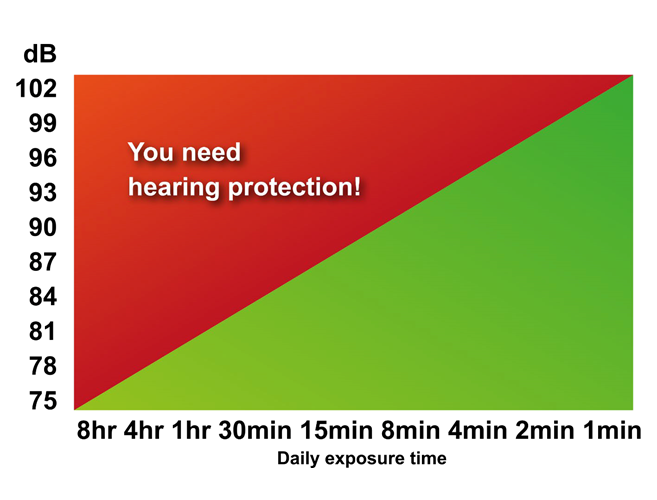
Working on-site all day means that noise is constantly being poured into your hearing. But what many people don’t realise is that every noise source and the length of time you’re exposed to it has an exposure level measurement, and you’ll be surprised how quickly you can reach the maximum daily safety exposure dose without proper protection.
For instance, drilling into wood at 92 decibels would only give you 10 minutes safe exposure against your full day’s allowance!
Drilling into metal creates 96 decibels of noise, a chain saw 99 decibels, a circular saw 101 decibels, drilling into concrete 108 decibels, and an angle grinder 109 decibels.
So take a look at the chart here and you’ll see that if you haven’t got proper hearing protection, you shouldn’t be on-site working and handling tools for very long at all!
Choosing The Right Hearing Protection
Luckily its relatively easy to look after your hearing. Its a simple case of always using hearing protection when exposed to harmful noise and if necessary, choose a protector adapted to your work environment, ie a product with ‘level-dependent hearing protection’.
Hellberg Safety recommends that the calculated level under the hearing protector should be around 75 decibels given that its real-life (attenuation) performance may be affected because of the incorrect fitting, misuse and poor maintenance. Performance protection can even be affected by anything that impairs the hearing protectors seal, such as long hair, facial hair and glasses!
Finally here are some useful tips. Choose hearing protection that fits correctly and is comfortable the entire time you are exposed to noise at work and even if you’re mowing the lawn or strimming.
Make sure you’ve got 100% wear time in noisy environments and remember, the use of eyewear can reduce the hearing protector’s attenuation of between 3-8 decibels, so if possible, select thin eyewear frames.
Finally, your health and wellbeing on site is just as important as getting a job done quickly, efficiently and in comfort. So choose your PPE products carefully and with that in mind check out the Hellberg Safety website www.hellbergsafety.com where you’ll find all the information you need on choosing precisely the right kind of passive or active hearing protection whatever you’re doing or wherever you’re working on site.
Leading where others follow, Snickers Workwear stretch fabrics deliver unrivalled comfort and close quarter mobility on site.
Snickers Workwear’s hi-tech fabrics and body-mapping designs give plenty of scope for every professional craftsman and woman to stretch their performance on site comfortably. Designed for a wide variety of jobs on site, these LiteWork 4-way stretch work trousers are the ideal choice if you’re working hard in warmer weather.
For maximum flexibility in getting work done, these new Trousers feature detachable holster pockets while the trousers themselves are made from full-stretch material for maximum mobility wherever you’re working while the Cordura®-reinforced Kneeguard™ pockets offer additional comfort and protection.
For maximum functionality, there’s also ruler, and cargo pockets for easy access to tools and fixings. They’re all Cordura® reinforced for durability. So check out these newest designs – the optimal choice for craftsmen and women who need to get the job done quickly efficiently on site.
We’re excited to bring you our new extension project series featuring James King from The Supreme Finishing Company who has taken on a huge extension building project and intends to carry out much of the work himself.
https://thesupremefinishingcompany.co.uk
In this first part, Roger takes a tour of the house with James to look at all of the work that’ll keep him busy for the foreseeable future.
Roger checks out a few different impact driver bits, including our sponsor’s Shockwave drill bits.
With the launch of SHOCKWAVE in 2009, Milwaukee delivered the first line of power tool accessories specifically designed for use with impact drivers. As tool usage and technological advancements within impact drivers has rapidly increased, SHOCKWAVE has continued to innovate and provide tradesman with the best performing impact accessories available.
SHOCKWAVE will continue to be at the forefront of impact accessory technology and focus on DRIVING PERFORMANCE FORWARD.
Milwaukee SHOCKWAVE Durability
SHOCKWAVE Impact Driver Bits are the Most Durable, Best Fitting driver bits on the market. The WEAR GUARD TIP™ increases wear resistance, protecting bit fit over the life of the bit.
The Shockzone™ is optimized for each tip type and length of driver bit, absorbing peak torque and preventing breaking.
CUSTOM ALLOY76™ steel and heat treatment is customized for each tip type for up to 50X bit life. The SHOCKWAVE™ impact driver bits provide extreme durability for the most demanding job site applications.
Robin is joined by Ty Harnett to look at getting a really secure fixing for his showerheads to make them strong enough for chin-ups!
A faster, more robust and watertight connection for securing fixed shower heads, shower hose wall fittings, wall mounted taps and bar shower valves, WC’s and hand basins.
• Eliminate leaks within walls and floors
• Prevent pipes from being knocked or drilled
• Guarantees perfectly upright shower fittings
• DZR brass for exceptional corrosion resistance
• Reversible manifold for hollow and solid walls
• Dual seal within the wall structure
• Interlocking base plate for various applications
• Prevents depth planning of fittings or using offset adapters
Roger has a chat with Chris Wormald from Pipelife to look at the common misconceptions with plastic pipe.
Pipelife is a leading manufacturer & provider of plastic piping systems. Specialising in the extrusion of polyethylene (PE) pipes Pipelife offers industry-leading products for the heating & plumbing, water pressure, electricity, cable ducting, gas and agricultural sectors.
Drawing on over 45 years of manufacturing experience from their production plant in Cork, Pipelife has been at the forefront in developing innovative products and has been an industry leader for many years.
Superb insulation and full weather protection for optimal comfort on site.
Street-smart, stylish looks and market-leading GORE-TEX and 37.5® fabric technology make these jackets and trousers a must for winter on-site or for outdoor leisure activities.
You’ll stay warm and dry in this layered clothing that’s robust, waterproof and windproof too! The design and fabric combinations will keep your body in the optimum comfort zone as the weather conditions change on site.
They’ve got all the features and functionality that you’d expect in Snickers Workwear Jackets and Trousers. They’re great-looking garments that will keep you feeling comfy wherever you are and whatever you’re doing at work in cold weather.
With a range of winter accessories to choose from as well, Snickers Workwear’s FlexiWork and ALLroundWork garments feature contemporary designs packed with must-have features that focus on fit, comfort and freedom of movement as well as using innovative fabrics that deliver long-lasting protection.
Admittedly the video didn’t discuss the many causes of damp in buildings and could have been a whole lot longer, but we felt that it targeted a specific cause of damp and gave a simple solution that is widely used and effective. What is more, it is a very easy job for a DIYer.
So far so good but the comments that followed the posting of this video took us completely by surprise. Some people were not happy. It transpired that there is a significant body of people in the U.K who sincerely believe that rising damp is a myth.
These are not scientists or people with any real knowledge of building technology, they are people who have latched onto a single simple premise and pushed it beyond its logical conclusion.
They have gained traction on social media in the same way as people who purport the earth is flat and that Elvis, Kurt Cobain, and Prince are happily residing on some heavily guarded South Sea Island.
No Such Thing as Rising Damp
The anti-rising damp brigade is lead by a couple of gurus who, in keeping with most fundamentalist, are deaf to any argument but their own. I quickly learned that it is a waste of time arguing with such people or their followers.
It seems that conspiracy theorists are not that discerning and once they believe in one conspiracy theory, they adopt anything and everything that falls under that heading. People who say that rising damp is a myth are more likely to see other scientific phenomena as myths. One such person even put forward the idea that the Moon doesn’t exist.
Pressed on this he said that it was some kind of manmade illumination but didn’t know why it was put there let alone when and by whom. Yes, they really are barking mad.
This kind of thing is now just part of the rich tapestry of modern life and we could all just laugh it off if it were not for the fact that people who really ought to know better are persuaded that there is some substance in the claim that ‘Rising Damp does not exist’.
Damp Conspiracy
The fact that all new building in the UK has to have effective damp proof courses to prevent this supposedly non-existent menace is to them all part of the conspiracy. Now I am entertained by a conspiracy theory as much as the next person but if you are going to have a conspiracy theory surely there has to be a more exciting one out there than ‘rising damp is a myth’? Imagine a weekend conference where people show each other photographs of rising damp and claim they have all been doctored in Photoshop.
When asked for evidence of the nonexistence of rising damp the devotees often cite Venice. For some strange reason, they believe that Venice does not have rising damp.
It makes me wonder if they have ever been to Venice. Not only does Venice have significant rising damp, but the University of Bologna also has a whole department dedicated to research into the problems of rising damp in ancient buildings.
It is government-funded because the Italian government knows all too well that rising damp is a real threat, not only to Venice but to many historic buildings in other parts of Italy.
Water Water Everywhere
The denial of rising damp is even more baffling when you recognise that it is everywhere and even has some beneficial properties. Damp rises through tiny capillary veins or tubes and through this process millions of gallons (or litres) of water move from the ground up through the less dense sapwood of trees and out through the leaves.
If you cut a tree open, you will not find a pump or any moving parts. The capillary pathways in masonry and mortar have the same effect. Damp evaporates out of the masonry and more is drawn up from the ground.
The whole existence of our planet depends upon the principle that damp rises either through capillary action or evaporation. The clouds in the sky are the most visible example of rising damp and if you look at the wick in an oil lamp you will see rising damp being put to good use.
With such overwhelming evidence, it is hard to work out why some people insist that there is no such thing? The answer may lie in the fact that rising damp has been over-diagnosed. People keen to sell damp treatments are, in some cases, looking at condensation or penetrating damp and calling it rising damp simply because it gives them an opportunity to sell a product.
Damp Treatment Professionals
The term Snake Oil Salesman is often used to describe these ‘damp specialist’ but to dismiss everyone in the industry as a Charlatan because of a small number of rogues is unfair.
We are told by the detractors that all a building needs is to breathe which really means that it needs air passing through it to move damp to the outside. The idea that it might be good to prevent the damp entering in the first place is, for some strange reason, ignored.
There is also a belief that damp is a modern problem that simply didn’t exist in the good old days. So there we have it, a modern problem that is caused by us.
Newly Dampened
It is true that newly built homes were once left unoccupied for six months to allow them to dry out. This was prudent because a huge amount of water is used to build and plaster out a house and that water has to go somewhere.
These days we tend to dry buildings out by heating them but without ventilation all the heating does is to cook up a fugg. Even after the initial drying out process, if it happens, water is still generated by cooking, bathing, showering and breathing.
That water needs to be moved to the outside often by mechanical extraction. This used to happen naturally in the time of open fires many rooms had a chimney, and with the fire lit, this produced as many as eight complete air changes to the room every hour.
That is the real reason why homes did not seem to suffer from damp in the way they do now. Modern draughtproofing means, we are now looking at as little as one air change per hour and sometimes not even that.
We keep the heat, but we also keep the airborne moisture and the result is condensation, which since the compulsory introduction of damp-proof courses, is now a lot more of a problem than rising damp, but that is not to say that rising damp no longer exists.
Diagnosed Damp
It is perfectly possible to have more than one cause of damp in a home and that is why it needs to be diagnosed properly before any attempt is made to reduce it.
It also needs to be acknowledged that the less well off are more likely to have damp homes. If you are struggling to pay the heating bills you may not want to open a window or even switch on an extractor fan. If you are poor you may also be living in a home with higher occupancy.
The more people living in a house, the damper it is likely to be. It may also be the case that the occupants are drying washing indoors and not heating every room which is just about the worst combination there is. Airborne moisture will move from heated rooms to unheated rooms and condense on cold surfaces which quickly produces ugly black mould.
Damp is not only a building issue it is also a political, social and health issue. The rise in asthma among children is undoubtedly due to poor air quality both inside and outside our homes. Mould is toxic and those who suffer most from such conditions are the young and the old.
Blame Game
It is common for landlords to be blamed for damp houses and there are often news items demonising uncaring landlords. Of course, such people exist, and they need to be held to account but sometimes the tenant’s lifestyle (living habits) is to blame.
A tenant may be looking at the black mould forming around the tops of skirting boards and blaming it on rising damp whereas the landlord is looking at the washing drying on the radiators and thinking it is more likely to be condensation forming on the lower part of the wall, which is always colder.
In such a climate of claim and counterclaim, it is little wonder that people take up polarised positions. As with so many problems these days our first reaction is to find somebody to blame.
The Oxford University-led Infrastructure Transitions Research Consortium (ITRC) has developed globally unique methods for simulating future population, housing growth and demand for infrastructure services. The methods explore how the necessary infrastructure can be provided affordably, securely and sustainably.
In a significant report published today, the ITRC, led by the University of Oxford’s Environmental Change Institute, has deployed these methods to reveal a series of insights to inform the Oxford-Milton Keynes-Cambridge Arc – one of the UK’s largest housing and transport projects.
The report’s executive summary can be requested directly to the media contact below.
The report provides a preliminary analysis of key questions across travel time, carbon footprint, water usage, housing developments, pollution and environmental impact.
It found that careful planning for new settlements could allow development whilst still protecting greenbelt land and other natural habitats, better management of energy and water needs, and a lower carbon footprint than with unplanned scenarios.
Findings include:
Higher growth expansion and development of new settlements could result in up to 5.4 million and 6.1 million people respectively living in the Arc area by 2050.
Planned road expansions and developments may initially generate some travel time savings, but are insufficient to prevent travel time increases in the longer term.
To address travel time, additional steps must be taken to manage demand for road travel (e.g. via shifts to rail) and reduce congestion.
The vision of a carbon neutral Arc is achievable with the greatest challenge being how to heat new and existing buildings without using fossil fuels.
Insulation and energy efficiency solutions in existing and new homes should be implemented first, followed by the introduction of low-carbon heat technologies.
Water use in the Arc is predicted to double by 2050, and new reservoirs and effluent reuse schemes could aid in meeting demand.
At the eastern end of the Arc, the development of new cities scenario could result in a doubling of the annual risk of water shortages.
To preserve the Arc’s natural environment, it will be necessary to develop a ‘Green Arc’ vision where natural capital thinking is embedded throughout.
The development must be carefully planned to preserve and integrate existing natural capital assets, create new green corridors for people and wildlife.
Jim Hall, Director of the UK Infrastructure Transitions Research Consortium and Professor of Climate and Environmental Risks at the University of Oxford, said:
‘The Oxford-Milton Keynes-Cambridge Arc is the most far-reaching housing and transport development proposed in recent decades, akin to a British Silicon Valley. One million new homes could be created by 2050, along with a new road Expressway, a new rail link and new and innovative forms of urbanisation.
The future of the Arc is likely to be made up of a complex combination of many different development options, with differing typologies of development dependent on changes to existing urban centres or introduction of new towns or cities into the region.’
The UK’s National Infrastructure Commission (NIC) made recommendations in its 2017 report to develop the Arc as a knowledge-intensive economic cluster across the heart of England.
However, there is currently a challenge around the Arc’s implementation as local authorities and central government have lacked independent systemic analysis due to the complexities of planning for such an unprecedented complex project. The ITRC approach fills that gap and helps inform decision-making at all scales.
Pioneering tool
ITRC is independently applying its models and analytics to explore possible futures for the Arc, evaluating and quantifying the impact of local, regional and national choices on sustainable future options.
The ITRC’s Arc studies are unique in their breadth and depth, bringing together data on the whole range of infrastructure that would be required, along with population modelling and forecasts, energy, transport, water and digital communications requirements.
Professor Hall said: ‘ITRC’s modelling will help to create a clear vision for the Arc’s grey and green infrastructure, employment and housing. The tool is highly flexible and can analyse a multitude of different scenarios at varying scales.’
As well as modelling the Arc, ITRC’s analysis has been used in UK research as well as internationally with governments and organisations including UNOPS, World Bank and governments around the world.
Professor Hall said: ‘Built well, infrastructure can demonstrably and positively contribute in areas from economic prosperity and employment to health, education and the safeguarding of the planet’s natural resources.’
The principle of the “system of systems” approach pioneered by ITRC means it is uniquely placed to model a cross-sectoral approach to developments.
Professor Hall said: ‘This means investments in infrastructure can be properly costed, planned for long-term sustainability and resilience to natural hazards, and looked at from a systems perspective rather than on a project-by-project basis.’
ITRC’s National Infrastructure Systems Model (NISMOD) can also be used to identify complexities such as how failure in one network or area might impact on another – from a single power station going down to the impact of massive flooding across a city on transport, businesses and homes.
The mounting specialist fischer further expands its competence in the area of power tools. The new fischer cordless impact drivers FSS 18V make the safe mounting of the fischer concrete screws ULTRACUT FBS II faster and easier. With these powerful devices, fischer also becomes the currently 13th member of the Cordless Alliance Systems (CAS). This makes the new impact drivers 100 percent compatible with the battery packs and chargers of currently twelve other leading power tool and machine manufacturers.
Nürtingen/Waldachtal, September 2019: “As partner of the cross-manufacturer battery pack cooperation CAS we embark on new paths to the cordless construction site”, says Florian Birkenmayer, speaker of the management Mounting Systems of the fischer Group of Companies. Thanks to CAS, the new fischer cordless impact drivers FSS 18V and the machines from currently twelve additional power tool and machine manufacturers can be used with the same battery pack and charger. “Like this, professional users always have the right product available for all standard to special tasks”, says Florian Birkenmayer.
Further advantages: “CAS provides users with more mobility and safety, since they can work far away from a power outlet and there are no more tripping hazards due to cables. Furthermore, users can change from one product to the other with the same charger and battery pack, and thus work with significantly more flexibility and productivity. The tools and machines of the CAS cover almost all industries and work with high efficiency on the basis of the Metabo battery pack technology – the currently most powerful battery pack technology on the market thanks to LiHD. Around one year ago, CAS started on initiative of the Nürtingen power tool manufacturer. With fischer, the cooperation has now already 13 partners. Another four companies have already joined the alliance and work on CAS-based production.
The focus is on the system concept
As system provider, fischer offers its customers a complete programme for safe and economical connections on the construction site. “Therefore, the CAS cooperation perfectly suits our concept, nevertheless, the system concept is the focal point. With CAS users not only can use our new cordless impact drivers FSS 18V, but also about 140 more machines with the same, powerful battery pack. This is innovative, economical and saves time”, says Florian Birkenmayer.
Reinforcement for CAS
fischer’s broad range of products has the right solution for all mounting applications: It comprises mounting systems in the chemical, steel and plastics industry, screws, drill bits, adhesives, sealants and foams as well as assortments specially designed for applications such as facade and composite heat insulation systems or also installations in the sanitary, heating, ventilation and electric sector, which are also of interest to the other CAS partner companies. “fischer is an important reinforcement for CAS”, says Horst W. Garbrecht, Metabo’s managing director. “fischer is known everywhere as mounting specialist. This not only opens additional markets for CAS, but it also gives us a proper boost in terms of publicity. We are very happy to have an additional, very renowned partner at our side.”
Two variants of high performance
In addition to the particularly fast and safe mounting of the fischer concrete screws ULTRACUT FBS II, the new cordless impact drivers FSS 18V are suitable for example also for steel-steel connections. The high-performance devices are available in two variants: The FSS 18V 400 BL has a torque of 400 Newton meters and a brushless motor. Suitable to the respectively available diameter of the ULTRACUT FBS II the torque can be regulated. The FSS 18V 600 has a torque of 600 Newton meters and is thus ideally suited for the assembly of the fischer concrete screws in diameter 10 to 14.
The professional user receives an all-round carefree package for the fast mounting of concrete screws. The ULTRA-CUT FBS II concrete screws are, depending on the diameter, approved for many different anchorage depths, respectively matching to the existing load. In addition, there are different head shapes, versions made from galvanised and stainless steel, 6 mm diameter versions especially for redundant mountings and much more. The concrete screws can be adjusted and re-used if certain conditions are met. Like this, fischer always provides the right ULTRA-CUT FBS II for almost any application case. All fischer concrete screws with 6 to 14 mm diameter can be processed with the respective cordless impact driver FSS 18V. In the tool case, fischer delivers the right accessories of belt hooks, sockets, test sleeves and much more free with the cordless impact driver FSS 18 V. This facilitates the mounting process, undoing the ULTRA-CUT FBS II and check for reuse. Also, the robust L-Boxx as tool box permits the stacking of several compatible cases on top of each other and thus transport them comfortably on the construction site.
Cordless connection: Within battery pack system CAS, which is unique in the industry, worldwide leading manufacturers bundle their know-how by the fact that their tools and machines are 100 percent compatible with the same powerful Metabo battery pack technology. One of the currently around 140 CAS machines is the new cordless impact driver FSS 18V 400 BL from fischer.
One battery, many solutions. Thanks to this idea CAS permits that users can change in a flexible and mobile manner, as needed, between the fischer cord-less impact drivers, such as the FSS 18V 600 (image), and all other tools and machines within the battery pack system. Delays due to non-existing power outlets and cable as tripping hazards are a thing of the past.
About CAS
The Cordless Alliance System (CAS) is a cross-manufacturer battery pack system initiated by the Nürtingen power tool manufacturer Metabo. In the summer of 2018, CAS started with nine power tool manufacturers and machine manufacturers from different sectors. Currently, the following companies are part of CAS: Metabo, Rothenberger, Mafell, Eisenblätter, Collomix, Haaga, Electrostar (Starmix), Eibenstock, Steinel, Rokamat, Elried/edding, Birchmeier and fischer. Within this battery pack system that is unique in the industry, all machines of the CAS partners are one hundred percent compatible with one battery pack and can be combined at will. Based on the powerful Metabo, CAS unites different trades under one roof and thus offers professional users the freedom to work with standard and special products of different manufacturers mobile and flexibly far away from any power outlet. More on CAS at www.cordless-alliance-system.de.
About Metabo
Metabowerke GmbH in Nürtingen is a traditional manufacturer of power-tools for professional users from the core target groups of metal trade and industry as well as building trade and renovation. Metabo stands for very powerful cordless tools and is the leading supplier in the battery pack sector with its LiHD technology. In this way, Metabo has turned its vision of the cordless construction site into reality. The LiHD technology is also the basis of the battery pack system CAS (Cordless Alliance System) that comprises machines and power tools of different industry-specific manufacturers. Under the brand name Metabo, the full-range supplier provides machines and accessories for all standard applications, but also competence products and system solutions for special requirements. Founded in 1924 in the Swabian town of Nürtingen, Metabo today is a medium-sized company which also produces also in Shanghai, China, in addition to its headquarters in Nürtingen. 25 subsidiary sales companies and more than 100 importers ensure international presence. More than 2,000 people work for Metabo worldwide, and in the financial year of 2018 (April 2018 to March 2019) they have generated a turnover of 493 million euros. More about the company Metabo and its products can be found at www.metabo.com.
About fischer
The Group of Companies with headquarters in Waldachtal, Northern Black Forest, has achieved a turnover of 864 million Euro in 2018 with around 5,200 employees worldwide. The family-run business is represented in 35 countries with 47 subsidiaries and exports to more than 100 countries. It comprises the five company sectors fischer Befestigungssysteme, fischer automotive systems, fischertechnik, fischer Consulting and LNT Automation.
fischer Befestigungssysteme owns the technological market leadership in important fields of fastening technology. fischer offers products in technical perfection for a wide range of customers, from handymen and craftsmen to the key account partner.
fischer automotive systems manufactures high-quality interior components for vehicles. The company has a high expertise in plastics processing and is an important partner of the automotive industry. The product range comprises air outlets, beverage holders, storage areas and multi-functional components.
fischertechnik with its construction kits, is active both in the toy sector and in the educational sector. fischertechnik is one of the last toy providers to develop and manufacture exclusively in Germany.
fischer Consulting was born from the competences developed in the own company. Residing there is the fischer ProzessSystem, the central content of which is the permanent improvement. The fischer ProzessSystem orients itself always on the benefit for the customer. fischer Consulting provides advice to medium-sized companies, authorities and large companies on the path to slim and efficient processes.
LNT Automation develops and manufactures customer-specific electronic solutions. Furthermore, the company is involved in the development, the manufacture and the sale of customer-specific and capacitive touch systems such as multi-touch solutions made from glass and matching controller units. The electronics are manufactured in-house. More about fischer at www.fischer.group.
Makita’s new 40V Max system will stand side-by-side with the industry-leading LXT System.
Since the launch of 18V ‘LXT’ in October 2005, Makita has led the way in cordless tool innovation and technology. The Makita Corporation’s objectives for constant improvement in designing innovative products for the construction and garden machinery sectors, will soon see the launch of a new generation of high power 40V Max ‘XGT’ cordless products.
To meet market demands for greater cordless power and to recognise the needs of professional contractors, Makita is expanding the cordless portfolio with the announcement of 40V Max ‘XGT’. This new cordless tool and battery platform produces greater power for high demand applications, increased durability, and a wider range of products to offer the performance that is comparable to petrol engine or mains powered machines.
XGT will stand side-by-side with Makita’s industry-leading 18V LXT System, giving industrial users a wider choice of battery-powered tools and equipment to achieve a truly cordless job site.
Makita’s 18V ‘LXT’ range currently has over 200-products that meet demands across a wide range of applications. Makita will continue to invest heavily in the 18V LXT system, with more new products planned to ensure continued support for customers who have already invested in the 18V ‘LXT’ platform.
18V LXT utilises a single battery across hundreds of products, with the ability of added power by using two 18V batteries in series on the current range of Twin 18V (36V) LXT products. This simple concept has revolutionised how work is undertaken by contractors, however the introduction of the Makita 40V Max ‘XGT’ range in Spring 2020 will offer a new and improved solution to benefit many applications where heavy-duty performance is required.
Why has Makita XGT been developed?
When visiting countries around the world, Makita R&D engineers have been challenged to design better cordless tools that can deliver more power, improved run-time, as well as being compact in size with an optimum weight for contractors to use throughout the working day.
XGT batteries look similar in size to existing 18V LXT batteries, however 40V Max ‘XGT’ is a new stand-alone system with its own range of tools, batteries, and chargers. Offering 40V Max power, the XGT range has been engineered to meet these industry demands as the market pushes for the transition to battery power.
A range of 40V Max ‘XGT’ products has recently been launched in Japan with a plan to introduce the new product range in Europe for Spring 2020. More information will follow in the early part of 2020.
Makita’s global focus is innovation; new technology and products that satisfy the needs of customers across many industries. Supported by heavy investments for today, tomorrow and the future, the market is, and will be, changing and Makita is positioned to lead this change.
NEW Winter Jackets and Gilets – insulated and water-resistant
These new ALLroundWork Jackets and Gilets are just what the name suggests – delivering great all-round performance on-site with a Ripstop water-resistant outer fabric and a coated inner fabric for extra durability.
They’re wind-resistant too and all have the features and functionality that you’d expect in Snickers Workwear clothing. Designed for optimum comfort and flexibility when you’re on the move, they’re great-looking working clothes that will keep you feeling comfortable wherever you are and whatever you’re doing at work in cold and windy weather.
With smart designs and an ergonomic fit, Snickers Workwear ALLroundWork garments are packed with must-have features that focus on functionality and freedom of movement as well as using innovative fabrics that deliver long-lasting protection. There’s also a range of Base- and Mid-layer garments plus accessories like gloves, hats, face warmers and beanies to ensure that every part of you stays dry and warm.
Home security has never been more accessible, thanks to the app-enabled upheaval that’s been going on for over a decade now. The myriad professional monitoring systems and DIY devices can make your head spin.
It’s hard to tell which ones are worth considering. Home security providers can make comparison shopping quite difficult. However, the market is beginning to crystalise. Here are a couple of solutions that have shown to be excellent at improving home security.
Smart Lights
Burglars are always on the lookout for empty homes. If they can tell you are at work or on vacation, they’ll raid your home. So, how do people deal with it? They leave the lights on. The oldest trick in the book, right?
Simply turning your lights before you head out doesn’t work anymore. However, switching your smart lights on is a completely different story. Smart lights mimic your daily patterns. You can use them to enhance the security measures you already have in place.
August Smart Lock Pro
You can make your home safer by replacing your front door’s deadbolt knob with an internet-connected, battery-driven, Bluetooth-enabled lock controller. The device renders old-school keys useless.
August Smart allows you to track who is entering and leaving the house. You can also use it to lock and unlock doors via the designated smartphone app.
There’s also a feature that allows you to give other people digital keys with time controls. Its voice assistant can be integrated with Siri, Alexa, and Google Assistant.
SimpliSafe
If professionally installed systems seem like overkill to you, you can take matters into your own hands. At first, DIY systems were just a low-cost solution than couldn’t match higher-end systems. Now, they have evolved into something far greater and SimpliSafe is the perfect example of that.
It’s easy to use, easy to install and has a great reputation in the industry. The set includes battery-powered sensors, security cameras, and a security-code keypad. Aside from its security features, SimpliSafe provides fire and flood monitoring.
However, you can’t count on high tech security systems to take care of everything. While they can make a huge difference in case of an emergency, it’s better to make sure your fire duct system is configured properly and that there are no hazards like carbon monoxide lurking about.
SimpliSafe also offers a professional monitoring plan. App support costs a bit extra, but it allows you to pair the device with Alexa and Google Assistant. DIY security kits are mostly designed for smaller homes and flats and were first used in Oggi Townhomes.
Nest Secure
If you want to be fully integrated into Google’s smart home ecosystem, Nest Secure may be a better choice. However, even though it’s a DIY solution, it’s a bit on the pricier side.
Its tag device is it’s signature feature that makes it stand out. The separate tag device allows you to lets pets, family members, and friends pass without the system identifying them as a threat.
The basic set includes one hub, two Nest Tags, and two motion detectors that you can attach to windows or doors. You can use voice command to set the system, thanks to the built-in Google Assistant. The company offers a couple of great extra features.
For Instance, the Nest Detect allows you to snag footage of the intruders. It enables your cameras to automatically snap photos of intruders, even when they are not turned on. You can also opt for professional monitoring.
Ring Alarm
It takes less than twenty minutes to set up this device. The system itself tells you exactly what goes where! The Ring app allows you to connect your base station to your WiFi. It comes with a motion detector and contact sensor. To activate them, simply remove the tabs. Ring also comes with a keypad, range extender, and base station.
Ring Alarm is one of the most inexpensive solutions out there. Ideally, you’d want to pair it with a security camera or two. Ring’s Video Doorbell is a cool add-on that allows you to see (and hear) who’s knocking at the front door when you are not home. You can access the smart doorbell via Ring’s smartphone app.
Alfred Security App
If you’re not willing to spend a small fortune to protect your home, this is a simple and free high-tech solution. Chances are, you have an old smartphone lying around somewhere and collecting dust. If it’s an Android, you’re in luck.
The Alfred security app allows you to turn your phone into a security camera (microphone as well). The app also offers push notification and employs motion detection. You can even take snapshots and use the two-way-talk feature.
Conclusion
With high tech security becoming increasingly popular, you can improve your home’s protection without breaking the bank. Now, with a bit of research, everyone can have a smart home that keeps its occupants safe. Each of these systems promises to offer peace of mind. It’s up to you to wage the pros and cons and decide which one suits your family the best.
The construction industry is getting behind a new scheme designed to simplify and strengthen the construction prequalification process.
According to CHAS, who was the first recognised assessment body to certify companies against the new Common Assessment Standard, over 30 of the construction industry’s biggest names have announced their support for the scheme since it was launched in May 2019. At the same time interest among contractors, who recognise early sign up as an opportunity to get ahead of their competition, is extremely high.
Led by Build UK and the Civil Engineering Contractors Association (CECA), the Common Assessment Standard replaces a multitude of prequalification schemes with a simplified process based on a single industry-agreed questionnaire. Once the new system is fully up and running it will be the primary route to prequalification in construction replacing the need for clients to specify a specific assessment body. Meanwhile, contractors will only need one annual assessment, saving both parties time and money.
The Common Assessment Standard is based on existing PQ questionnaires, including PAS 91, but its remit is broader, covering topics including Modern Slavery, Finances, Sustainability and Corporate Social Responsibility, reflecting an overall drive towards more stringent supply chain standards that reflect recent changes and priorities in the marketplace.
CHAS Managing Director, Ian McKinnon comments: “CHAS is the first recognised assessment body to certify companies against the Common Assessment Standard living up to our reputation for leading the way in driving standards in prequalification.
“CHAS is very proud to be at the forefront of the new scheme working with some of the biggest names in the industry. With a reputation for providing the best service at the best value, CHAS is committed to making accreditation as accessible as possible. Equally, for contractors who require additional support, CHAS has a package of membership offerings designed to help their clients to be the best.”
To find out more about the Common Assessment Standard and how to get accredited, contact CHAS today on 020 8545 3838.