Sunday, January 25, 2026
spot_img
Home Blog Page 110

Printing 3D Concrete

0
This latest one is printing 3D concrete..

Simply load up the shape and dimensions of what you want to build and watch it chug away building up layer upon layer of concrete.

If I had a pound for every time I have seen an invention that promised to revolutionise house building I would have at least £32.50 by now.

It looks a lot of fun and I would love to see it work but somehow I suspect it is destined for the dustbin of history.

The inventor’s claim that printing 3D concrete could lead to cheap housing might well be true if we had cheap land.

It isn’t labour that pushes up the price of houses, what makes homes expensive is the rationing of land through the planning process.

I am not suggesting that we allow a free for all but we should at least acknowledge that it is land prices not labour that pushes prices beyond the reach of even those who build them. A 3D printer will not change that.

The Future Of The Construction Industry

How Concrete Homes Are Built With A 3D Printer

Flooding Tackled Today

0

Well, we can’t say they didn’t warn us about climate change; more rain, rising seas, extreme weather. The television is full of images of flooding homes and the miserable aftermath. People being interviewed say that they have never known it this bad. Houses that were once considered above the flood plain, are now being deluged and everyone is looking for someone to blame for the flooding. Try Jeremy Clarkson.

Flooding needs to be tackled long before the water reaches town…

A week before the flooding I was down in Kent, with a company that was installing Smart Air Bricks, backflow prevention devices, and Flood Gates in a vulnerable cottage near the river Medway. It was just in time for the latest deluge, but did those preventative measures work? To some extent yes, in that they kept the water out to the specified height, but the water was higher than it had ever been; there comes a point (around 750mm) where it is better to let the water into the house, in order to equalize the water pressure on both sides. If this is not done then there is a risk of the walls being pushed in.

An interesting thing about water pressure is that it’s directly proportional to the height of water (static head) and is not affected by the amount of water that lies behind it. So a two foot wall at the end of Lake Windermere will have the same pressure on it as a two foot wall around a swimming pool. This allows us to calculate the forces precisely. However this doesn’t allow for surges. If the water is travelling towards you in a wave, that energy has nothing to do with static head.

Water will also find its own level so what you have on the inside you have on the outside, which is useful because it stops the walls being pushed in. In the case of a cellar flooding, it’s unwise to pump it out if the water table on the outside is too high. It may also be futile.

That said, it’s heartbreaking to stand and watch your home being flooded and any small thing you can do to reduce the impact of flooding must be better than simply sitting there watching nature take its course.

There is a great deal that can be done to reduce risk of minor flooding starting with the use of basic sandbags, and then moving up the scale in terms of expense, but not necessarily effectiveness. In particular you should not neglect the loo. You can sandbag all around the house but if the water level rises it has a route in through the drains and can pour out through the loo.

Leaving aside DIY flooding solutions, lots of people are now asking what more the Department of the Environment can do. One thing is certain, the problem needs to be tackled long before the water reaches town. In some cases this might mean diverting rivers and water courses or building sea defences. It might also mean building homes higher out of the ground. There is no reason why this can’t be done; it’s done all over the world. Houses on stilts! The technology has been there for centuries we have just been too complacent.

Flooding aside, there are also people who are finding water coming into their house through the roof and walls where it has never appeared before. If you get enough rain, it will drive through brickwork and mortar courses, which is why some of those DIY flood prevention devices are dubious.

In the normal course of events with heavy rain you wouldn’t necessarily know it’s happening, because the water runs down the inside of the outer skin, and is drained through weep holes in the mortar courses. However, problems often occur where the house has been extended on the ground floor, and a wall which was previously on the outside now finishes on top of a steel beam. Where then, is that water which runs down between the inner and outer wall going to go when it hits the beam?

The answer for many is into their nice new extension. If the builder has been diligent, this won’t happen because he/she will have put in cavity trays above the newly formed opening. The trays need to be above the roof line so the water can be drained out onto the extension roof, but I know many builders who simply don’t bother doing this, because it involves chopping out mortar courses and inserting the trays one by one to form a cascade. In most cases they get away with it because the rain never normally manages to drive that far through the brickwork, but we live in extraordinary times.

People are talking about ‘freak’ weather conditions. I love the use of the word ‘freak’ it’s applied to all sorts of things that really don’t warrant it. Admittedly the weather is unusual but storms are not freaks of nature. The British Building Regulations recognise this, and makes provision for unusual weather. That is why the regulations specify cavity trays. So the builder who glibly says to the client, “yeah we are dealing with freak weather conditions here”, is looking to blame something other than his/her negligence.

The opposite to negligence is zealousness or over-zealousness. I often see instances where home owners have spotted those weep holes above the window lintels, or on the cavity trays and filled them up, believing them to be holes that were overlooked during the construction process. This for me is the easiest kind of problem to put right. It takes ten minutes with a masonry drill to clear them out. Sometimes you are treated to a nice little jet of water coming out of the hole. It is as satisfying as lancing a boil.

Why are we building new homes on flood plains?

How To Protect Your Property From Flooding

Theatre Ceiling Collapse – A curious incident

0
The Apollo Theatre ceiling collapse

The recent incident of The Apollo Theatre ceiling collapse – on to the audience – thankfully resulted in no deaths, though it appears there are some very serious injuries. No doubt even many of those lucky enough to have escaped unscathed will have nightmares and may hesitate to enter old buildings for a while. At the very least they will become habitual ceiling watchers from now on.

As is so often the case there was a knee jerk reaction as inspectors scurried around in ceiling voids checking the ceilings of other London theatres but why stop at theatres? There are plenty of other old buildings with high ceilings and it’s quite possible that they too are within a whisker of dropping, but it isn’t always easy to tell.

Such a tale is likely to induce paranoia in those living in old houses but how do you know if your ceiling is safe?…

I have some experience of this from carrying out loft conversions in old houses. There is a stage of the job when you are obliged to walk across the ceiling joists in the loft to install steel beams before you can build the new floor. This flexes the ceiling and loosens the bond between the lath and the plaster. Nowadays I make sure that the ceilings are propped from below during this stage to eliminate deflection in the joists but I wasn’t always so diligent. It took a ceiling collapse to wake me up to the dangers.

The piece of ceiling collapsed into the hallway of a Victorian house, crashing down through the stairwell and landing in the front hall. It filled, and almost demolished, a pram where minutes earlier a baby had been asleep. It was only sheer luck that the baby woke up hungry after its outing and her mother took her through to the kitchen to feed her. The weight of the chunks that were fished out of the pram would surely have killed it or given it life changing injuries. I still see that child from time to time.

Such a tale is likely to induce paranoia in those living in old houses but how do you know if you’re at risk of ceiling collapse, and what do you do about it if you suspect it?

If you have a lath and plaster ceiling with lots of cracks in it that looks even slightly lively, you can have it replaced but often the quicker and cleaner option is to board it over. This of course is not an option on a ceiling with ornate plaster. Another good cure is to pour a few buckets of diluted PVA across the laths from above. This has the miraculous effect of soaking into the plaster and sticking it to the laths, binding the whole thing together.

Undoubtedly the cause of the Apollo theatre ceiling collapse will be discovered soon, and there’s no point speculating but I have seen plenty of ornate plaster ceilings that have been damaged by leaking roofs. Often the leak is not discovered for many years because the timber and plaster soaks up the water, and the heat from the building dries it out before a stain appears. This is the perfect recipe for rot.

The answer of course is rigorous maintenance. A thermal imaging camera will show up leaks in roofs, because damp is more conductive, and an inspection from above should establish the cause of the leak but all this costs money. Theatres, particularly those in listed buildings, are always walking the tightrope between getting bums on seats with high cost productions and saving enough money to look after the building.

Everyone hopes that a theatre will be fortunate enough to have a production that, using a critic’s cliché, ‘brings the house down’ but hopefully never literally.

More From Skillbuilder – How To Support A Load Bearing Wall

Prevent Ceiling Collapse – Common Causes Of Damage

Sticking Doors

0

It’s raining again and it looks set to carry on for days. My daughter phoned to say that the problem of damp around one of her windows has returned. She lives on top of a hill and the gable end of her house catches everything that nature can chuck at it. We have had all summer to fix the problem, but we left it. Somehow when the weather is topping 28 deg centigrade it is hard to think about damp.

In our defence, she is going to have the house extended next year, so she was hoping it might be OK until then. It isn’t, and if there’s a break in the weather I will be up there with some Dry Zone solution giving it a quick going over.

Those sticking doors lie between you and a lifetime of drudgery, it’s your finger in the dam…

Meanwhile back at my house, there are things that need doing. There are always things that need doing. My wife has a list as long as her arm and it never seems to get any shorter. A bloke I know told me a long time ago that you should never fix sticking doors, or whatever it is that your partner constantly complains about. His idea was that if you did that job, another one would be sitting in the holding bay ready to take its place. You would never be free, so the best strategy is to hold your ground against the onslaught.

“Never break ranks. Those sticking doors lie between you and a lifetime of drudgery, it’s your finger in the dam!” he said.

I liked him, he was completely un-reconstructed but amusing. He gave me lots of advice, most of which I failed to heed. I fixed the squeaky door and – he was right – I haven’t stopped since.

I bumped into him the other day – no not in the builders’ merchants – and he has retired. He has a nice new apartment with a balcony overlooking the golf course.

“Any sticking doors?” I asked.

He looked at me nonplussed, so I reminded him of his advice.

He laughed, “Ah that, no there are no sticking doors, not yet, but if one starts to play up my wife sorts it out – she has learned a lot over the years”.

“Oh has she taken up DIY?”

“Goodness no, she gets someone in”.

Rising Damp Conundrum

0
Rising damp is not usually baffling..

I have always been a sucker for a challenge. If someone tells me that they have a problem that nobody has been able to fix, I am there. Rising damp is not usually baffling but rising damp in a third floor flat is. Yes I do mean rising damp and not penetrating damp, the proof being that some of it was on internal walls. But where was it coming from?

The homeowner, a well known television and radio presenter, had been royally ripped off. I am not sure it was completely intentional, as in – ‘he’s famous and has loads of dosh so I will take some from him’, but when you get someone who has a bob or two, there’s not the same tendency to be cautious as there would be with a vulnerable pensioner.

So in they went, these damp specialists, and hacked all the plaster off the internal walls, injected them and applied waterproof render and new plaster. It made a right mess and the whole flat had to be redecorated. It cost thousands but they guaranteed the work. Six months down the line the rising damp was creeping back and the homeowner couldn’t get them to answer his calls.

…the fact that the rising damp kept coming and the whole place was growing mouldy suggested that the plumber had got it wrong.

Then he got in touch with a plumber who came round and told him that it was very likely a pipe under the screed which was leaking. It was a good hunch because the damp seemed to be concentrated around all the radiators. His cure was to cut off all the under floor pipework and run it on the surface. This meant taking the pipes up and over the doorways with little air release valves at the high points – in a luxury London apartment one thing was certain, it didn’t add value.

The plumber took his money and told the homeowner he would have no more trouble. You can sort of see why he was so confident. There were no more pipes under the floor and as it clearly couldn’t be rising damp on the third floor what else could it be? Personally I would have started from that point rather than ended on it. It could be the heating pipes but what else could it be?

The fact that the damp kept coming and the whole place was growing mouldy suggested that the plumber had got it wrong. At the point where I got involved the home owner was about to hire a surveyor.

“Let me take a quick look first,” I said.

“Ok, but I don’t see what you’ll be able to find out if the others haven’t solved it.”

Then I said the magic words. “If I don’t solve it I won’t charge you a bean.” And he was hooked.

I soon noticed that there were ducts in the floor which had carried the heating pipes from the boiler to the radiators. If the central heating had been leaking these would have provided a perfect distribution network around the flat so you could see where the plumber was coming from but why didn’t he pressure test the heating before cutting it off? Whatever the reason he had now taken all the live pipework above the floor so it couldn’t be that.

So what else could be leaking into those ducts? The first thing I did was trace the route of the ducting by tapping on the floor and listening to the hollow sound of the screed. It ran along the hallway and into the bathroom and under the bath to the airing cupboard.

I removed the bath panel and could see the uncovered duct running under the bath. It ran right along the middle between the bath feet and right under the bath waste. The little flexible overflow pipe which is normally just a push fit onto the bath overflow spigot had come loose and was dangling in the duct. Every time the man or his partner had a shower or a bath, the water would pour out of the flexible hose into the duct and out through the mini canal system to the point where it met the walls.

I grabbed a Jubilee (worm drive) clip from my van, reattached the hose and secured it to stop it from ever dropping away again.

“I will guarantee that job for life”, I said and I meant it because there was no way it would ever come off even if you tugged at it which begs the question – ‘Why don’t manufacturers include a clip on those hoses in the first place?’.

Don’t tell me, I already know the answer. They have a responsibility to a small army of tradesmen depending on the work it creates.

More From Skillbuilder – Rising Damp Exposed

Rising Damp – Capillary Action

Why Your Shower Tray Leaks

0

I went to look at a shower tray leak today. It was the usual story, a leak around the tray. The water was pouring out. The householder had been trying to solve the problem for months. He had even renewed the grout and silicone on the bottom three courses of tiles and still the water poured out onto his lovely oak floor.

For 15 years I was the DIY expert on a London Broadcasting show called The Fix-It Phone In, hosted by the talented Therese Birch, and we used to get asked the same leaking shower tray questions week after week. The first thing people do when they get a leak around a tray is to squirt silicone all around the inside – big mistake. If there was a chance of finding out where the leak was coming from, the application of half a tube of silicone ruins that prospect at a stroke.

Despite the fact that someone had been busy with the silicone I could tell straight away where today’s leak was coming from, but one thing I have learned about fault-finding is to never assume. I always go through the basics regardless of hunches. Each possibility has to be eliminated by evidence, not by guesswork.

The fact that large house builders employ silicone specialists on all their properties explains why leaks around shower trays remains the number one call back on new homes

First I played the water all around the tray where it met the wall. No leak. Then I moved slowly up the wall. Still no leak. Then I aimed the spray into the corner where the shower screen wall profile meets the wall. Still no leak.

It is necessary when carrying out these tests to stand in the shower and it is also necessary to replicate the weight of the person who normally uses the shower. This can be difficult at times. I took my socks off so I could stand in the right position and then I gradually raised the height of the spray up the corner profile. Suddenly the water started pouring out from the back of the profile.

I knew immediately that the hollow profile had simply filled up with water. On every shower screen installation instruction sheet I have ever seen it says, “Do not seal around the inside of the shower screen.” But the reason is hardly ever explained. The frame or wall profile will fill up and it needs to leak into the tray. A DIYer could be forgiven for not knowing this and perhaps not reading the instructions but the silicone seal was applied by one of the growing band of silicone sealant specialists who ought to know better. The guy who did this job had clearly never read the instructions on a shower screen installation but even if he had, the fact that he follows the plumber after the installation means he can never do the job properly.

There is an order in which things must be done.

The first job is to seal the tray against the wall. The second job is to tile. The third job is to grout and the fourth job is to apply the second run of silicone. Only then can you fit the profile to the wall, fit the surround panels and seal around the outside. If the job isn’t done in this order it is not just a possibility that it will leak, it is inevitable.

The fact that large housebuilders employ silicone specialists on all their properties explains why leaks around shower trays remains the number one call back on new homes. It is a problem that has persisted for years and in this respect, the building industry remains stubbornly resistant to change.

Shower trays can also crack, see our video on this subject.

Pointing, Are You Missing the point?

0
Does one have to be brain dead in order to enjoy pointing?

I have been re-pointing some brickwork this week. Despite having a shed full of various pointing guns I was doing it the old fashioned way with a hawk and a Marshalltown tuck pointer. The reason for using hand tools as opposed to the compressed air gun was simply to reduce noise. The customer has a one week old baby and I didn’t want the compressor kicking in and scaring the living daylights out of the poor mite.

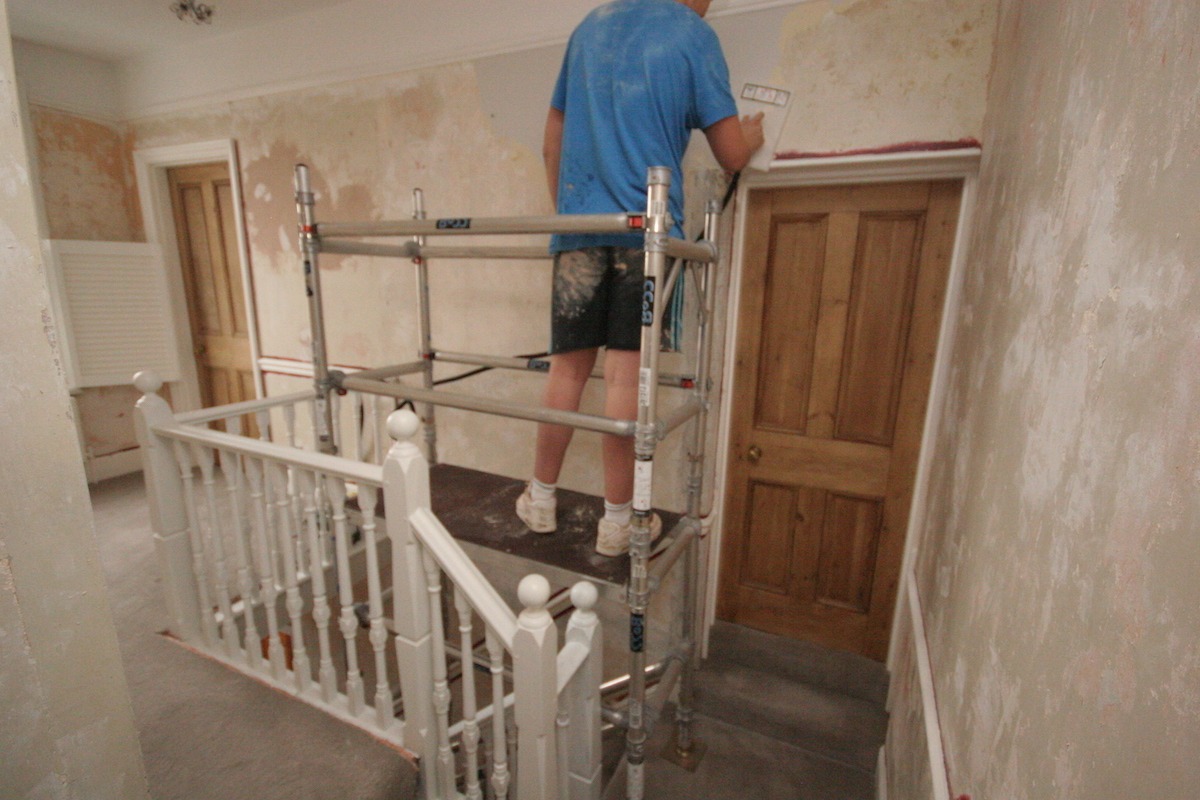
So I had a very pleasant couple of days out on the scaffold tower watching the world go by and listening to the birds sing. My builder friend Steve dropped in to see me and made a comment about having to be brain dead in order to enjoy pointing. OK, I am brain dead but it is stress free and the repetitive nature of the work is strangely satisfying. This is probably because I don’t do it day after day for the rest of my working life. It is in effect a holiday.

…the big difference between what they were doing and what I was doing was the magic ingredient of being outdoors.

When I was a kid I used to see television footage of car workers on assembly lines. They were on the news because they were on strike. That happened a lot in the sixties and even at my young age I had a great deal of sympathy. Faced with the nature of their work, the noise and the grim prospect that they would be doing it day in day out until they won the football pools, I would have found any excuse to walk out into the sunshine.

The big difference between what they were doing and what I was doing – pointing brickwork – was the magic ingredient of being outdoors. A lot of building workers like being out in the open, it’s why they joined. Admittedly it isn’t much fun in January but there is still something appealing about it. Whenever some bright spark comes up with yet another system-built house put together in the factory and hails it as the end of site built housing I hang my head low.

Yes it is more efficient and probably cheaper, it may even have better quality control but it isn’t nearly as much fun. The measurement of job satisfaction isn’t something that economists think much about. The fun footprint is not measured in the way that carbon is. That is a shame because it figures large in people’s lives. It would be nice to have a little stamp on products saying that the maker enjoyed making it. I would put one on my brick pointing, a little smiley face hidden in the mortar lines. A little message for the future generations of builders.

More From Skillbuilder – Working Beyond Retirement, Preference Or Pressure?

Its A Wonderful Life – Working Outdoors

Why help to buy?

0
Help to Buy scheme…What could possibly go wrong?

It never ceases to amaze me how many politicians never seem to see beyond their next move. They certainly aren’t chess players. Yet again we see another politician blundering into a trap as obvious as any fools mate. His eye is firmly fixed on the immediate prize and he seems to be blind to the dangers. If only he could step back a bit and look at the whole picture.

People are warning David Cameron that his Help to Buy scheme will produce the opposite outcome to the one he intends, but he refuses to see it. “Trust the Bank of England” he cries. He might just as well have prefaced that with “If you can’t trust me”. His declared motive for the policy is that he doesn’t think it is fair that the only people who can afford to get a foot on the property ladder are those with rich parents. Quite right David.

…In many ways it resembles a student loan but instead of investing in a person the tax payer is investing in property.

So in order to even out this inequality he feels so deeply about, he has cast the British tax payer in the role of rich parent. We are about to lend would be purchasers of houses under £600,000 a full 20% of the market value through a Help to Buy scheme. In many ways it resembles a student loan but instead of investing in a person the tax payer is investing in property. What could possibly go wrong?

The government has been warned that this well intentioned move will fuel another housing bubble pushing prices even further out of the reach of first time buyers. We have seen that house prices rise in proportion to people’s ability to take out, but not necessarily to repay, the loan. Think toxic loans, financial meltdown, Northern Rock.

There is also a danger that a lot of this money will be used by people who don’t need it. It will be easy enough for those looking for a quick buck, to take the government money, buy a property, run around the board twice to see it rise by 30%, sell the property and pay the government back. But the even greater danger is that the bubble will burst and once again thousands of people will find themselves in negative equity. With only 5% of their own money tied up in the property there will be very little to stop those Help to Buy victims cutting their losses and throwing in the keys. We have been there before.

This is not a Monopoly game, people need houses to live in not to speculate with. Tinkering or rigging the market will not provide long term stability let alone cure a housing crisis. To take the heat out of the housing market we need to build more homes. Nothing else will work.

Help To Buy – Equity Loan

First Time Buyers Guide

The Beautiful Game (not quite)

0

Qatar, host nation of the 2022 World Cup, (that is soccer for our American followers) is busy building the infrastructure for the games. An expected 500,000 migrant construction workers will make their way across the Indian Ocean to provide the labour and for many it will be a one-way ticket.

Put bluntly the Health and Safety record on construction projects in this fabulously wealthy nation would be criminal if normal laws applied. Sharon Burrows, general secretary of the International Trades Union Confederation, predicts that more people will die building the stadia, roads and hotels than will take to the pitch through the entire tournament.

If each of those players came out with a black armband for the construction workers who will die it would shock the world, but it won’t happen. For a start the rulers of Qatar will not release the figures even if they keep them, which is doubtful.

It is estimated that one worker a day dies in Qatar on these projects and as deadlines loom and require higher output this figure will not go down. No guest worker in Qatar has the right to join a trade union and they must obtain an exit visa from their employer to leave the country. Any worker speaking out would, therefore, be imprisoned.

…part of the bidding process to host this prestigious event ought to include statements on workers’ welfare and on-site safety.

The workers are quite simply seen as disposable. Not all the deaths occur through incidents, some are the result of working long hours in extreme heat. If you think playing football for 90 minutes is hard in 50 deg cent try shovelling concrete.

People are worked to death and die in their sleep crammed into tin huts with no air conditioning. Yet these are not seen as work-related deaths even though they are in construction camps.

Surely part of the bidding process to host this prestigious event ought to include statements on workers’ welfare and on-site safety. It is scandalous that a nation as rich as Qatar cannot see its way to providing basic human rights to its ‘guest’ workers.

When you compare Qatar to the health and safety record of the London 2012 Olympics you begin to see that our triumphs as a host nation started long before the opening ceremony. Rather than ridiculing ‘health and safety’ we should be proud of achieving the safest ever construction project on the planet.

If the rulers of Qatar have no sense of shame then it is up to others to shame them. It is too much to hope that an organisation with the track record of FIFA will expend much energy in this area but ex-players such as David Beckham, who command the attention of the world’s media, are in a perfect position to champion the cause of these workers where nobody else can.

A well-timed and accurately placed statement from him would score a goal for human rights and seal his reputation as a true ambassador of sport.

Green Deal or no deal

0
As soon as I saw the way this green deal was shaping up I knew it was in trouble..

The British government has been working on ‘The Green Deal’ for several years now. It was originally the brainchild of the previous Labour government, but the coalition took the idea on and brought it to fruition. I say ‘fruition’ but that is hardly an accurate description because it has failed to even blossom, let alone bear fruit. There are currently just four households in the UK that have signed up. Yes that is four not four thousand or even four hundred.

When the government first started consulting on this scheme a lot of interested parties sat on endless committees and contributed their thoughts. As happens with these things people complained of being ignored but whenever you sift ideas there will be rejects and with that comes hurt pride. But looking at what got accepted I can’t help but wonder what the rejects looked like. They must have been very bad indeed because there seems to be no aspect of this scheme that appeals to the British homeowner.

A local builder could do the job just as well, probably better, for a fraction of the price…

As soon as I saw the way this green deal was shaping up I knew it was in trouble. The usual suspects began to emerge. Cold callers, ex double glazing salesmen in the guise of surveyors and people outside DIY stores with big smiles and clip boards. They were fooling nobody.

There are many aspects of the Green deal that are wrong. The extortionate interest rates being one, but the fundamental flaw is that there is no real competition for the work. When you look at some of the quotes being given for jobs such as insulation and double glazing, you start to get the idea that this is a cosy little club. At those prices and considering the 8% interest rate, the savings take too long to kick in.

A local builder could do the job just as well, probably better, for a fraction of the price. Furthermore, if the householder went to one of the High Street building societies, they would probably be able to secure a loan for 3 percent less than the ‘Green Deal’ rate.

So anyone who is serious about saving energy can either go through all the red tape and paraphernalia that seems to be part of any government package, or they can ring their trusted local builder who will come round on his way home, probably in his overalls not his suit, and give them an honest assessment of what is likely to be a good investment in energy saving.

Most of it is fairly obvious stuff, a new boiler, better controls, under-floor heating, draught proofing, double glazing, insulation and perhaps some solar panels.

The Green Deal – Overview

Experts Training To Deliver Green Home Scheme

Fake Chimney, Lost in Construction?

0
Fake Chimney Faux Pas

It might seem like a busman’s holiday but whenever I’m out enjoying myself, I still can’t stop looking at buildings. Now comes the bit where I inflict my holiday snaps on you, and if you are well brought up you say “nice” but anyway feel free to comment.

The first is someone’s ingenious attempt to protect a gable end wall from the weather. This is a common problem where a building has been demolished, leaving another to face the elements. Many people do a bit of vertical tile hanging, but this builder has left part of the roof of the demolished building ,and supported it on cantilevered purlins. Nothing too unusual about that I suppose, but look at the chimney.

It’s hanging in mid air. What possible reason could there be for leaving it there, and what is supporting it? This is not a glass fibre fake chimney; there is half a ton of brickwork up there.

It just looked wrong. If you are going to fake something, you do it properly or don’t bother…

On the subject of fake chimneys, which some house developers think adds character to their new homes, I saw one a while back that was clearly a fake. You could tell because you could see straight in through the bedroom window and where the chimney breast should have been, there was the open space of a large bedroom. It just looked wrong. If you are going to fake something, you do it properly or don’t bother.

The second picture I wanted to show you is a slate roof in Luxembourg. There are many fine examples of slate work in Northern Europe, particularly the numerous church domes. It seems that slaters just can’t resist trying to outdo each other.

Odd tiling in Luxembourg

On this roof they have not only swept up the cheeks of the dormer windows, but the whole slate roof has been run at an angle, rather than being parallel with the ridge. I could see no practical reason for doing this, but then I started wondering if it’s something to do with snow and ice. Slates laid on the slant are less likely to be dragged down if the snow slides off. Each one is held by the one below.

I have no way of knowing if this is the reason and I can see nothing in the roofing manuals that supports this theory, so perhaps they were just showing off after all – and there is nothing wrong with that. Perhaps that’s also what the fake chimney is all about.

More From Skillbuilder – Whats Supporting This Troublesome Chimney?

Why Have A Fake Chimney?

Washing Machine – Indecent Exposure

0
The fault lies not in the cupboard or the washing machine..

I had a call-back on a job today. The kitchen unit doors were knocking together. I assumed it would just be a simple matter of adjusting the self-closing Blum hinges and I would be on my way. It turned out that the hinges causing the problem were not Blums but the hinges attached to the washing machine.

For those of you in any nation but Britain I must just explain that we have this odd idea of putting the front-loading washing machine in the kitchen. Don’t ask me why it’s just the way it happens to be. Obviously we don’t like it because we then attempt to hide it behind a cupboard door so all you can see is a clean row of cupboard doors. There are two ways of doing this. One is to leave the doors on the cupboard carcass and the other is to attach the door to the washing machine itself.

The problem is that washing machines, especially front loaders, have a tendency to move slightly when they are in fast spin. Given that the gap between cupboard fronts is around 5mm on each side you can appreciate that you are on a hiding to nothing in trying to maintain that gap.

I explained to the customer that this is not an installation fault, but a design fault. The fault lies not in the cupboard or the washing machine but in the marriage between the two. The kitchen unit manufacturers cannot be expected to cater for a washing machine that walks and the washing machine manufacturer cannot be expected to stabilise the machine within such fine tolerances.

“So what” asked the customer “is the solution?” I thought for a while and eventually in desperation suggested. “The only solution is to remove the decorative door and expose the naked front of the washing machine”.

She was horrified. The idea of spoiling the nice clean line of kitchen cupboards with a washing machine front was so abhorrent that she could hardly believe I had dared suggest it. What kind of Philistine was she dealing with?

What I should have done at that point was tell her that there are some things in life that aren’t fixable but something in me resists that piece of logic.

I played around with the feet and repositioned the machine centrally. Then when her back was turned I took a couple of her tea towels and rammed them deep down into the gap on either side of the machine. I used a long spatula to make sure they were so deep that she wouldn’t detect them. In engineering you might call it a shim, which makes it sound a whole lot better than a bodge.

Skillbuilder Call backs – Why Your Shower Tray leaks

How To buy The Best Integrated Washing Machine

Under-floor Heating Timebomb

0
Under-floor Heating Troubles

As the popularity of under-floor heating increases we are inevitably seeing a larger number of faulty installations. This is the way of the building industry, but it needn’t be so. Plumbers are often called in to pipe up under floor heating manifolds to the heating systems after the floor loops have been laid by others.

Because it is trapped, the pipe expansion will take place within the walls of the pipe rather than along it…

Laying pipes into screeded floors might seem like a job for the labourer (beneath plumbers’ dignity) but entrusting this job to someone who doesn’t have the background knowledge is where mistakes are made, and hidden, until a future date when the pipes fail. The whole system might stand up to a pressure test and be assumed to be fine, but when laying heating pipe under screed you need to keep in mind that:

  • Plastic pipe expands and contracts as it heats and cools.
  • This expansion doesn’t cease when it is buried in sand and cement.

Because it is trapped, the pipe expansion will take place within the walls of the pipe rather than along it, but where the pipe leaves the cement screed and enters free air is a critical point. Suddenly it is able to expand and contract freely along its length and the point of transition is susceptible to abrasion. It must be sleeved at this point either with plastic conduit or pipe insulation to prevent this happening. If this isn’t done there is a risk of leaks occurring.

The other vulnerable point in under screed pipes is the thresholds between rooms. The screeds between rooms always crack at this point and this is a wholly good thing because it allows each room to act independently. It does however mean that the pipe at that point will move minutely and, again, abrasion can wear the pipes. This will also happen where pipes go through walls

Pipe failure could be 10 or 15 years from now, and whilst plumbers and builders will be free of their warranty obligations by then, it is not a long time in the life of a building, or perhaps I am out of step by thinking that pipe which is guaranteed for anything from 25 to 50 years ought to actually last that long in a building as well as a laboratory.

Which Underfloor Heating System Is Best For You?

Leveson Inquiry – Halls of Smoke and Mirrors

0
How will the outcome of the Leveson Inquiry will affect the behaviour of the British media?

Im not sure what the answer to this is, but it needs to get a move on before the High Court building falls into rack and ruin.

There’s also the possibility that the door is now a computer generated image and the reporter is just standing in front of a green screen…

The rendering on the pillar on the left hand side of the door has been patched and scratched in the most appalling way. A five year old could have done a better job. I would guess it was frost damaged last winter and since the enquiry has had a continuous stream of witnesses arriving and leaving through that doorway there has been precious little opportunity to cordon off the area and carry out a proper repair to the rendering.

Continuing this theme I have often wondered how the front door of 10 Downing Street is kept in such immaculate condition. Quick drying water based paint can’t be the answer because it’s such a high gloss finish. My theory is that they have two doors and simply swap them over when nobody is about. There is also the possibility that the door is now a computer generated image and the reporter is just standing in front of a green screen.

So much film and television is done in this way that it is sometimes difficult to establish what is real and what it not. It makes you wonder why they bother with those iconic backdrops for live outside broadcasts. Dragging crews out in the dead of night to give the illusion that they are somehow on the spot is such a waste of resources. Of course, if it did eventually happen that reporters claiming to be live on location around the globe were in fact tucked up in a nice warm studio out of harm’s way we would need to look into the ethics of such a thing. An enquiry into press ethics, where have I heard that before?

Leveson Inquiry Report – At A Glance

More From Skillbuilder – Rendering Tips For Patch & Repair Work

Landfill Tax – Take A Hike!

0
Massive Hike In Landfill Tax Announced

The Government has announced a massive hike in Landfill tax, and the building industry is up in arms! This is a charter for fly-tipping if ever there was one. Skip companies are saying that this will kill their business and they are planning to disrupt Jubilee celebrations, then the Olympics. They obviously fear for their livelihoods, but I wouldn’t be so sure that they will lose out.

After the U-turn over pastie tax, they probably think they need a softer target than the militant pastie eating hordes.

There is already a small army of pickup trucks roaming the streets, offering to get rid of rubbish for cash and we know that this rubbish is fly-tipped. It may sit there for a while but sooner or later it has to be removed and most of it is loaded into skips and finishes up in a landfill.

The only difference is that the people who’ll be paying the increased landfill tax, plus the cleanup charges will be the ratepayers. As local authorities have no money as it is, they will find this extra burden hard to bear; but bear it they must, because it won’t be long before the rubbish is piled high in the streets.

Rubble in skip

The declared intention of this landfill tax, is to encourage manufacturers to think about the reduction of waste, and for the geniuses in Whitehall it all looked so simple. We are sending too much to landfill, so we need to encourage recycling. We have come so far by voluntary actions, winning the hearts and minds of those with green roots, but now we need to punish those nasty builders etc. who are still chucking too much away. The only problem is that builders and home improvers feel they have been punished enough.

If you want to put a skip outside your house where I live it costs you £300, including the licence you have to pay the local authority for clogging up their roads. Post landfill tax hike, there will be a charge of £65 per ton which goes straight to government. I said the “declared intention” of this increase in tax is to reduce landfill, but a very handy spin-off is that the government raises much-needed revenue. After the U-turn over pastie tax, they probably think they need a softer target than the militant pastie eating hordes.

Having said all this, I have some sympathy for the cause of reducing waste to landfill. We do produce way too much rubbish and something needs to be done. The population is increasing, and we are constantly being told that we need economic growth. Growth means that we produce more than we did last year, and more the next year than we did this year. I am no Einstein, but more stuff means more rubbish.

Last year I built a modest extension on a house and by the time it was done I had used 12 skips. I wasn’t happy about this and would have loved to use half that number. What is now being suggested is that the skips are made so expensive, that I put pressure on the merchant and other suppliers to take their packaging back, or better still not to send it in the first place. I also know that stuff is wrapped for protection and ease of handling. If they put less wrapping on things there will be an increased risk of damage which means more wastage.

The only way that this landfill tax issue is going to be resolved is to have a massive increase in recycling, and that means letting builders bring their rubbish into local authority run recycling centres, or taking it back to merchants. I was recently in Germany where plastic and metal containers are brought back to the supermarket, and fed into a machine that sorts them out and gobbles them up. The shopper is then issued with a credit on their next purchase of tins and bottles. It seems to work, but that’s Germany for you.

Landfill Tax Rates

Dont Throw Your Foam Gun Away

Rustic Appeal

0
Does Rustic Appeal To You?

I came across this building up at Snape Maltings on the Suffolk coast. The original building was almost gone, and the new owners could have taken it apart bit by bit and rebuilt it with lime mortar, and importing used bricks to make up the considerable deficiency.

…there’s a touch of Antony Gormley’s Angel of The North in letting the metal brave the elements.

They decided on a different approach, which was to weld up some steel plates (boiler plate) rather in the manner of an upside down ship. The master stroke was to leave it unprotected – so it rusted. There is a touch of Antony Gormley’s Angel of The North, in letting the metal brave the elements. It may not be the kind of thing that many people want to live in, but among the restored Maltings and cottages of that area, this building stands out and I believe in a good way. Presumably they have some very effective insulation on the inside.

Tell me what you think.

Condensing Boiler Blunder

0
Condensing boilers have undoubtedly become more reliable over the last few years..

But the last couple of winters saw thousands of householders caught out by frozen condensate. Manufacturers offer clear guidelines for avoiding freezing, but not every job offers the opportunity to do things by the book and terminate the condensation inside the building. If the pipe runs to an outside drain, then there is always a chance that it will freeze. In response to this, we now have a number of products on offer which will stop condensate pipes from freezing. Invariably these use electric trace heating (electric blanket) for the pipe. An average cost for fitting trace heating is around £200.

…installers are being advised to redouble their efforts to find somewhere inside the building to terminate the condensate.

The question is who pays? If you’ve had a condensing boiler fitted in the last few years and have suffered a breakdown due to the condensate freezing, you might reasonably expect the person who installed it to carry out the remedial action free of charge, on the grounds that the boiler was not fit for purpose. However, it seems that many installers are arguing the point saying that practice of lagging the pipe should have been enough under normal circumstances to prevent freezing, and the only reason the pipes are now freezing is abnormal weather. In other words, the boiler will work fine so long as it doesn’t get very cold. Some would say that this misses the point.

The quick fix offered by many installers and manufacturers of condensing boilers last winter, was to take a kettle of hot water and pour it over the condensation pipe. It’s a very British solution to, ‘put the kettle on’ and the site of people out in their dressing gowns at 6am with steaming kettles has a kind of pathetic charm.

In the longer term, installers are being advised to redouble their efforts to find somewhere inside the building to terminate the condensate. Ideally, this will be a soil stack or waste pipe from a kitchen sink ,but I give full marks to a heating installer I came across the other week, who found a handy soil and vent pipe close by to put his condensate into. He drilled a hole and fitted a strap on boss (sounds pornographic if you aren’t a plumber) and left the condensing boiler in good working order.

A few hours later the householder called to say that there was dripping coming through the ceiling. The installer, being a psychic, said he knew the cause without even coming back to the house. It was the WC upstairs which was leaking.

The householder found it strange that this should happen at the very time the condensing boiler was fitted and the dripping had stopped since he switched off the boiler, but the installer insisted that it was nothing to do with him and told the householder that coincidences must happen, otherwise there would be no such word as ‘coincidence’. Not only was it nothing to do with him, but he wasn’t interested in fixing the problem because he was a heating installer – not a plumber. He hadn’t spent thousands of pounds gaining his gas safety certificates just to end up messing about with bogs.

So it came down to me, a lowly jobbing plumber, no job too small. It took me less than five minutes to track down the leak. It wasn’t coming from the WC at all; it was dripping out of the ceiling fan.

The reason it was dripping out of the ceiling fan was that the installer had terminated the condensate into a length of grey plastic soil pipe, that he took to be the vent section of the soil and vent pipe. It was in fact the vent duct from the extractor fan.

Mistakes happen and I wouldn’t judge him too harshly on this one, except for the fact that he still wasn’t putting his hands up to the error. He had taken the pipe to be a soil pipe in good faith when he had put in the estimate, and the fact that it wasn’t meant that he now had to run the condensate pipe some considerable distance to pick up the said soil pipe. Suddenly he was the aggrieved party.

The householder was faced with a bill for another £200 to do the job properly, or he could poke it out of the wall and take responsibility for it freezing. But if it did freeze all he would need is a kettle full of hot water.

Why Home Owners Love These Condensing Boilers

What Is A Condensing Boiler?

Building Site from Hell

0
I am currently working on the building site from hell..

It was a job I took on against my better judgment. When I was pricing it, alarm bells were ringing in my head because there was a new spec and drawing almost every day. The job itself isn’t actually that bad; it’s a complete re-plumb on a large central London house with an ensuite on every bedroom, and underfloor heating throughout. The money is good, but what makes it so difficult is the bloke running it. He calls himself a builder, but he has no idea.

Almost daily, my mate and me enter into protracted arguments with him about the difference between the way he says he does it in the Middle East, and the way we do it here. Invariably we walk off the job in protest at the latest demands. We only go back because the client, who is a lovely person deserving of much better than this idiot site agent, pleads for us to return. We agree, provided we can do the job the way we always do it.

“Even at this stage, there isn’t a day that goes by when the drawing doesn’t have an amendment…”

Quite what his appeal is we don’t know, but there is some kind of family link and it doesn’t do to get between family. Even at this stage there isn’t a day that goes by when the drawing doesn’t have an amendment; the boiler has been in three places, the shower room has changed, the bathroom has been turned 90 degrees and every pipe run is moved and moved again. We have three 90 degree spigot bends one after another on a horizontal soil run, because the architect had overlooked a steel beam that is in the way. It will block, we know it will. They will have to set up an account at Dyno-Rod.

It isn’t just us that are unhappy on this building site; every trade in the house has been subjected to the same kind of lunacy. Walls move, doors are altered this way and that and crazy demands are made. The vast expanse of folding patio doors had to be remade, because the floor insulation hadn’t been taken into account.

As is common on most building sites these days, there is every nationality under the sun. We all rub along very well and have a laugh and a joke united in our hatred of the common enemy, the site agent. We have been on to him for weeks to supply a porta-loo, but he gives us a bucket and we use it behind the shed. It’s a return to a time I thought was over.

His latest demand, when arriving at the building site, is that we turn on the central heating to dry out the floor screed. It was laid over our pipes only 6 days ago and he wants us to fire up the heating and dry it out so he can lay the oak flooring. I have told him it will crack and turn to powder if the moisture isn’t allowed to stay in it long enough for it to complete its hydration, which is usually 28 days give or take. I told him that until that time, the more moisture you can hold in the screed the better.

A screed is laid almost dry and it needs all the moisture to stay in and hydrate the cement, but Abdul knows best. Despite the fact that some of the tradesmen speak very little English, they all have this phrase “Abdul knows best” word perfect. For our part we are learning lots of new languages, or at least the swear words.

More From Skillbuilder – 1 In 10 Homeowners Unhappy With Building Work

Building Site Regulations

Fault Finding – A Plumber’s Tale

0
The golden rule that I have followed through years of fault finding is ‘never assume and never jump to conclusions’.

OK that is two fault finding golden rules, but the basic message is never say you know something until you prove it. This has stood me in good stead, where other tradesmen have come and gone from a job missing one small fact that changed everything. This is not superior wisdom, just hard won experience from getting it wrong. And sometimes I still get it wrong as this job proves.

I had been called out to look at a fault finding leak around the bath. It is almost always due to a defective silicone seal, but I didn’t just assume that. I checked it by spraying water all around the edge of the bath. Sure enough the water poured down. Positive proof! Fault finding completed!

The leak had been going for some while and made a real mess. We got the job to take the bath out, renew the rotten chipboard floor and cover the walls with Knauf Aquapanel, before re-tiling. This was the fourth flat in the block to suffer from these problems and it had caused bad feelings among the owners, so this customer didn’t want any further trouble from his bathroom. He didn’t mind paying for a good job, but he wanted a guarantee. Now I know there are some plumbers who would not put their name on a piece of paper that says ‘this won’t leak’ but I was 100% confident in both my plan and fault finding accuracy.

Firstly we were going to renew the floor, and then we were going to get rid of the plasterboard at the shower end and put up some tile backer board. We were also going to beef up the stud work to prevent any movement. Then we were going to tile the floor under the bath so the tiles came right up to the wall. The Ardex shower waterproofing system would then be used to make a damp proof membrane that ran down the walls behind the bath and onto the floor, so any leak would not be able to seep down under the floor.

There would be a silicone seal between the bath and the wall, and then another silicone seal after the wall had been tiled. It was near enough a week’s work to do this but I told the customer that I was sure after all that it wouldn’t leak, but if it ever did (which I doubted) he would know about it because the water would seep out from under the bath panel and appear as a puddle on the tiled floor. This might seem like belt and braces, but it is actually standard practice on the Continent, we are almost alone in ending the tiles just under the bath panel.

We obviously tested the bath waste, and even replaced the flexi tap connectors – just for good measure. I have heard too many horror stories about flexis springing a leak and would never use them in a flat. We finished on Friday lunchtime and everything looked good. That weekend I received a text saying that a puddle had appeared on the bathroom floor.

Fault Finding – Fault Not Found

It was Sunday morning but I went straight over. The leak appeared to be coming from the bath waste so I took it apart. There were traces of Plumber’s Mait on the underside of the waste, which indicated that this had been a previous problem which someone had tried to fix. We had obviously disturbed a bad repair. Plumber’s Mait is not suitable for bedding in wastes of any sort, but thousands of people use it for this job every year. If you ask Evo-Stik, the manufacturers, they will verify that it is unsuitable for wastes. If you need a sealant for wastes then silicone is much better.

I removed all of the Plumber’s Mait and, because the rubber seals looked fine, left them to do the job they were designed to do. I ran the bath and it looked OK. Monday morning I got another text ‘Bath still leaking, please fix today’. This time I decided to renew the whole pop up waste assembly. It looked fine.

Monday night text number three ‘still leaking, pissed off’. Looking on the positive side at least – the idea of tiling up to the wall and sealing the wall to floor joint had paid off with an early warning of what was really a small leak. If we hadn’t done this, then the people in the flat below would have been the first to know.

Fault Finding – Fault Found

I went back to the bathroom and after half an hour of having the bath full of water and nothing coming out, I wondered if the problem was more to do with the person using the bath, than the bath itself. He was a big guy and I wondered what difference it would make if you had another 110kg in the bath. It all seemed solid but would things start flexing? My next fault finding move was how to simulate this. I certainly didn’t want him sitting in the bath while I crawled about with a torch, even if he was willing. It would take a month of Sundays to get that image out of my head.

I lay there, head on the floor, deep in thought. It was at this point that the torchlight caught a single silver drop of water. It wasn’t coming from the waste; it was coming from the glass fibre of the bath. I pushed it with my finger and a few more drops came down. I discovered that the bath was spongy. I could actually push a blister of water around. Clearly it had leaked through the acrylic top and been trapped by the reinforcing coat of glass fibre. I shone the torch down through the water and there it was a hairline crack.

The one thing I hadn’t proved at the outset, was that the bath was watertight. Because 95% of leaks on baths turn out to be from around the silicone seal, I had jumped to the conclusion that it was the cause and I hadn’t looked at a secondary cause.

The task now was to remove the damaged bath (easy with a recip saw) and then fit a new bath, without damaging all those lovely new tiles or the new bath. That was slightly trickier because it was a snug fit. The customer, obviously not expecting to lose weight any time soon, decided to go for a steel bath. Good choice in his case.

When we cut that old bath in half you could see the weak spot. It was all along the edge of the chipboard reinforcing panel, where the inner acrylic joined the outer glass fibre. There was a triangular void all the way along both edges. It was inevitable that it would fail fat bloke or not, but the fact that the percentage of obese people in Britain has now reached epidemic proportions, means that plumbers will be busier with this kind of work. Something to bare in mind when fault finding in a bathroom for sure.

More From Skillbuilder – Fault Finding & Diagnosing Problems

Knauf Aquapanel Boards

Carbon Monoxide Poisoning Surge

0

I have just read that the number of carbon monoxide poisoning incidents has increased over last year. The reason isn’t entirely clear, but I will offer two suggestions.

Firstly, the exceptionally cold winter. Nearly all carbon monoxide poisoning is from open-flued appliances such as gas fires. These require a through-flow of fresh air from outside. Natural ventilation which may be tolerated during a mild winter suddenly becomes an icy blast. I saw several incidents last year where people had taped up air bricks and tried to seal every available gap around the doors and windows.

the need to keep going for refresher courses and paying out extortionate fees for registering has pushed out perfectly competent fitters…

Secondly, the cost of having a Gas Safe engineer out to service the appliance has risen because many people, such as me for example, who are not specialising in gas work find the Gas Safe registration and training courses too onerous for the amount of gas work I do. At most I may install five boilers a year and service another ten. This does not justify registration so I now end up getting them done by a sub-contractor.

I am all for safety but the need to keep going for refresher courses and paying out extortionate fees for registering, has pushed out perfectly competent fitters and given those left in the game the opportunity to charge more. I don’t blame them for this because they have to cover the cost of all those courses. As with so many things, it is the poor who suffer – particularly those in fuel poverty because they either forgo the annual service, or use an unregistered service engineer who may or may not know what he/she is doing.

My proposal is that the HSE lets people who prove their competence through an exam, register for a small fee. We would then pay a notification fee to Gas Safe for each appliance we work on. This would mean that those who did a small amount of work would not have to pay a disproportionate fee.

All gas work would be subjected to random inspections by local safety inspectors, who would be paid out of that fund. Any installation that didn’t pass a safety test would be shut down and the installer sent for training, or banned according to the severity. At present, there is a voluntary scheme where a household can nominate their gas work for random inspection. This leaves the householder feeling as if they are snitching on the installer (because the installer is informed by Gas Safe) and the installer may therefore be reluctant to return for annual servicing.

If there were a duty on the householder to send off the registration card, this would protect the consumer from such accusations and make sure that all gas work is subjected to random inspection. I am sure there are reasons why this would not work and there are those out there who may think it is no better than the system we have right now, but if the number of deaths from carbon monoxide poisoning is increasing, then it is clear that something isn’t working.

Another idea I will put up for discussion is for Gas companies to offer free service and safety checks to the elderly.

Building Company Fined – Children Risked Carbon Monoxide Poisoning

MORE FROM THE NHS

The symptoms of carbon monoxide poisoning are not always obvious, particularly during low-level exposure.

A tension-type headache is the most common symptom of mild carbon monoxide poisoning.

Symptoms of carbon monoxide poisoning

  • Dizziness
  • Feeling and being sick
  • Tiredness and confusion
  • Stomach pain
  • Shortness of breath and difficulty breathing

The symptoms of exposure to low levels of carbon monoxide can be similar to those of food poisoning and flu.

But unlike flu, carbon monoxide poisoning does not cause a high temperature.

The symptoms can gradually get worse with prolonged exposure to carbon monoxide, leading to a delay in diagnosis.

Your symptoms may be less severe when you’re away from the source of the carbon monoxide.

If this is the case, you should investigate the possibility of a carbon monoxide leak and ask a suitably qualified professional to check any appliances you think may be faulty and leaking gas.

The longer you inhale the gas, the worse your symptoms will be. You may lose balance, vision and memory and, eventually, you may lose consciousness.

This can happen within 2 hours if there’s a lot of carbon monoxide in the air.

READ THE FULL ARTICLE ON CARBON MONOXIDE AT NHS.UK